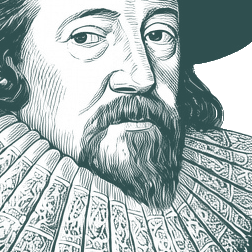
The lame (as they say) in the path outstrip the swift who wander from it, and it is clear that the very skill and swiftness of him who runs not in th… - Francis Bacon
""
The lame (as they say) in the path outstrip the swift who wander from it, and it is clear that the very skill and swiftness of him who runs not in the right direction must increase his aberration.
Francis Bacon, 1st Viscount St. Alban KC (22 January 1561 – 9 April 1626) was an English philosopher, statesman and essayist. His works argued for the possibility of scientific knowledge based only upon inductive reasoning and careful observation of events in nature. Most importantly, he argued this could be achieved by use of a sceptical and methodical approach whereby scientists aim to avoid misleading themselves. His general idea of the importance and possibility of a skeptical methodology makes Bacon the father of the scientific method. This marked a new turn in the rhetorical and theoretical framework for science, the practical details of which are still central in debates about science and methodology today.
Biography information from
Wikiquote·
Portrait adapted from
Wikimedia Commons, Paul van Somer I / Formerly attributed to Frans Pourbus the Younger (Public domain / CC0)
Also Known As
Alternative Names:
Franciscus Bacon
•
Francis Bacon of Verulamius
•
Francis Bacon, Lord Verulam
•
Bacon, Francis, 1561-1626
•
Francis Bacon, Viscount Saint Alban
Portrait from Wikimedia Commons. Credit: Paul van Somer I / Formerly attributed to Frans Pourbus the Younger. Used under Public domain / CC0. Processed and styled by Quotewise.
Enhance Your Quote Experience
Enjoy ad-free browsing, unlimited collections, and advanced search features with Premium.
We have also sound houses, where we practice and demonstrate all sounds and their generation. We have harmonies which you have not, of quarter sounds and lesser slides of sounds. Divers instruments of music likewise to you unknown, some sweeter than any you have; together with bells and rings that are dainty and sweet. We represent small sounds as great and deep; likewise divers trembling and warblings of sounds, which in their original are entire. We represent and imitate all articulate sounds and letters, and the voices of beasts and birds. We have certain helps which set to the ear to do further the hearing greatly. We have also divers strange and artificial echoes, reflecting the voice many times, and as if it were tossing it; and some that give back the voice louder than it came, some shriller and some deeper; yea, some rendering the voice, differing in the letters or articulate sound from that they receive. We have also means to convey sounds in tubes and pipes, in strange lines and distance (…).
Tot astfel în ce privește mântuirea: alegerea și planul trimit la Tatăl, actul propriu-zis și săvârșirea sa [trimit] la Fiul, iar realizarea la Sfântul Duh; căci prin Sfântul Duh S-a întrupat Cristos și prin Sfântul Duh renasc spiritual aleșii.
Enhance Your Quote Experience
Enjoy ad-free browsing, unlimited collections, and advanced search features with Premium.
"Very great, in short, is the prerogative of constitutive instances; for they are of much use in the forming of definitions (especially particular definitions) and in the division and partition of natures; with regard to which it was not ill said by Plato, "That he is to be held as a god who knows well how to define and to divide.