THE SECOND class of powers, lodged in the general government, consists of those which regulate the intercourse with foreign nations, to wit: to make … - Alexander Hamilton
""
THE SECOND class of powers, lodged in the general government, consists of those which regulate the intercourse with foreign nations, to wit: to make treaties; to send and receive ambassadors, other public ministers, and consuls; to define and punish piracies and felonies committed on the high seas, and offenses against the law of nations; to regulate foreign commerce, including a power to prohibit, after the year 1808, the importation of slaves, and to lay an intermediate duty of ten dollars per head, as a discouragement to such importations.
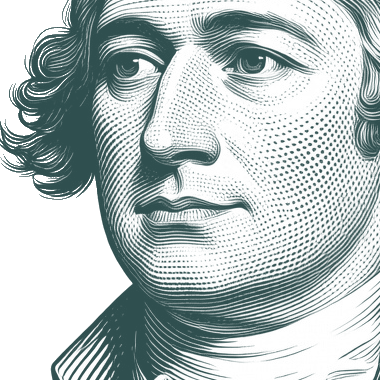
Alexander Hamilton (11 January 1755 or 1757 – 12 July 1804) was a Founding Father of the United States, chief staff aide to General George Washington, one of the most influential interpreters and promoters of the U.S. Constitution, the founder of the nation's financial system, the founder of the Federalist Party, the world's first voter-based political party, the Father of the United States Coast Guard, and the founder of The New York Post.
Biography information from
Wikiquote·
Portrait adapted from
Wikimedia Commons, John Trumbull (Public domain / CC0)
Also Known As
Pen Names:
Publius
Alternative Names:
Hamilton
•
Alexander Hamilton, US Treasury secretary
•
A. Ham
It were doubtless to be wished, that the power of prohibiting the importation of slaves had not been postponed until the year 1808, or rather that it had been suffered to have immediate operation. But it is not difficult to account, either for this restriction on the general government, or for the manner in which the whole clause is expressed. It ought to be considered as a great point gained in favor of humanity, that a period of twenty years may terminate forever, within these States, a traffic which has so long and so loudly upbraided the barbarism of modern policy; that within that period, it will receive a considerable discouragement from the federal government, and may be totally abolished, by a concurrence of the few States which continue the unnatural traffic, in the prohibitory example which has been given by so great a majority of the Union. Happy would it be for the unfortunate Africans, if an equal prospect lay before them of being redeemed from the oppressions of their European brethren! Attempts
rapacious. To look for a continuation of harmony between a number of independent, unconnected sovereignties in the same neighborhood, would be to disregard the uniform course of human events, and to set at defiance the accumulated experience of ages. The causes of hostility among nations are innumerable. There are some which have a general and almost constant operation upon the collective bodies of society. Of this description are the love of power or the desire of pre-eminence and dominion — the jealousy of power, or the desire of equality and safety. There are others which have a more circumscribed though an equally operative influence within their spheres. Such are the rivalships and competitions of commerce between commercial nations. And there are others, not less numerous than either of the former, which take their origin entirely in private passions; in the attachments, enmities, interests, hopes, and fears of leading individuals in the communities of which they are members. Men of this class, whether the favorites of a king or of a people, have in too many instances abused the confidence they possessed; and assuming the pretext of some public motive, have not scrupled to sacrifice the national tranquillity to personal advantage or personal gratification.
Unlimited Quote Collections
Organize your favorite quotes without limits. Create themed collections for every occasion with Premium.
A strong body makes the mind strong... I advise the gun. While this gives moderate exercise to the body, it gives boldness, enterprise, and independence to the mind.