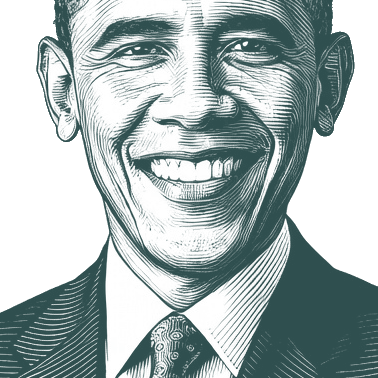
The document they produced was eventually signed, but ultimately unfinished. It was stained by this nation's original sin of slavery, a question that… - Barack Obama
""
The document they produced was eventually signed, but ultimately unfinished. It was stained by this nation's original sin of slavery, a question that divided the colonies and brought the convention to a stalemate until the founders chose to allow the slave trade to continue for at least twenty more years, and to leave any final resolution to future generations. Of course, the answer to the slavery question was already embedded within our Constitution - a Constitution that had at its very core the ideal of equal citizenship under the law; a Constitution that promised its people liberty, and justice, and a union that could be and should be perfected over time. And yet words on a parchment would not be enough to deliver slaves from bondage, or provide men and women of every color and creed their full rights and obligations as citizens of the United States. What would be needed were Americans in successive generations who were willing to do their part - through protests and struggles, on the streets and in the courts, through a civil war and civil disobedience, and always at great risk - to narrow that gap between the promise of our ideals and the reality of their time.
Barack Hussein Obama II (born August 4, 1961) is an American politician who served as the 44th president of the United States of America from 2009 to 2017. Born in Hawaii, the son of a Kenyan father and a mother from Kansas, he won the 2008 presidential election and was re-elected president in November 2012. A member of the U.S. Democratic Party, he was the first African American president. Before becoming president, he represented the 13th district for three terms in the Illinois Senate from 1997 to 2004 and served as United States senator from Illinois between January 4, 2005 and November 16, 2008. While president, he was the recipient of the 2009 Nobel Peace Prize.
Biography information from
Wikiquote·
Portrait adapted from
Wikimedia Commons, Official White House Photo by Pete Souza (Public domain / CC0)
Also Known As
Birth Name:
Barack Hussein Obama II
Also Known As:Barry
Alternative Names:
POTUS 44
•
Barack Hussein Obama
•
Barack H. Obama
•
Barack Hussein Obama, Jr.
•
Barack H Obama
•
Barak Obama
•
Barry Obama
•
Barack Obama II
War, no matter what our intentions may be, brings suffering and tragedy.
To all of you who served in Afghanistan, you can take enormous pride in the progress you helped achieve: Driving al Qaeda out of its camps. Toppling the Taliban. Delivering justice to Osama bin Laden. Helping Afghans improve their lives. There are millions of boys and girls in school, and democratic elections and a democratic government. Training Afghan forces to take responsibility for their own security so that we are no longer engaged in a major ground war in Afghanistan. That is your legacy. And today we salute our forces serving there on a more limited mission -- supporting Afghan forces, going after terrorists -- because we must never allow Afghanistan to be used as a safe haven for terrorists to attack our nation again.
Politics is a battle of ideas. That's how our democracy was designed. In the course of a healthy debate, we prioritize different goals, and the different means of reaching them. But without some common baseline of facts, without a willingness to admit new information, and concede that your opponent might be making a fair point, and that science and reason matter - then we're going to keep talking past each other, and we'll make common ground and compromise impossible.