Great thinkers build their edifices with subtle consistency. We do our intellectual forebears an enormous disservice when we dismember their visions … - Stephen Jay Gould
""
Great thinkers build their edifices with subtle consistency. We do our intellectual forebears an enormous disservice when we dismember their visions and scan their systems in order to extract a few disembodied “gems”—thoughts or claims still accepted as true. These disarticulated pieces then become the entire legacy of our ancestors, and we lose the beauty and coherence of older systems that might enlighten us by their unfamiliarity—and their consequent challenge—in our fallible (and complacent) modern world.
English
Collect this quote
About
Stephen Jay Gould
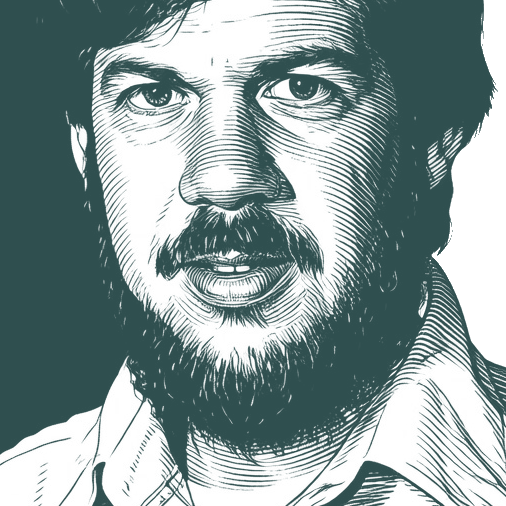
Stephen Jay Gould (September 10, 1941 – May 20, 2002) was an American geologist, paleontologist, evolutionary biologist and popular-science author, who spent most of his career teaching at Harvard University and working at the American Museum of Natural History in New York. He was one of the most influential and widely read writers of popular science of his generation.
Biography information from
Wikiquote·
Portrait adapted from
Wikimedia Commons, Lawrence Lipke (Public domain / CC0)
But our strong desire to identify trends often leads us to detect a directionality that doesn’t exist, or to infer causes that cannot be sustained. The subject of trends has inspired and illustrated some of the classic fallacies in human reasoning. Most prominently, since people seem to be so bad at thinking about probability and so prone to read pattern into sequence of events, we often commit the fallacy of spotting a “sure” trend in speculating about causes, when we observe no more than a random string of happenings.
When people learn no tools of judgment and merely follow their hopes, the seeds of political manipulation are sown.
Enhance Your Quote Experience
Enjoy ad-free browsing, unlimited collections, and advanced search features with Premium.
We do not inhabit a perfected world where natural selection ruthlessly scrutinizes all organic structures and then molds them for optimal utility. Organisms inherit a body form and a style of embryonic development; these impose constraints upon future change and adaptation. In many cases, evolutionary pathways reflect inherited patterns more than current environmental demands. These inheritances constrain, but they also provide opportunity. A potentially minor genetic change […] entails a host of complex, nonadaptive consequences. […] What “play” would evolution have if each structure were built for a restricted purpose and could be used for nothing else? How could humans learn to write if our brain had not evolved for hunting, social cohesion, or whatever, and could not transcend the adaptive boundaries of its original purpose?