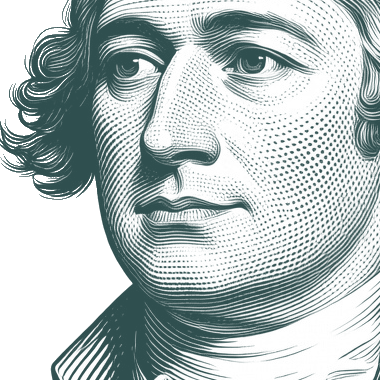
The President is to have power, with the advice and consent of the Senate, to make treaties, provided two thirds of the senators present concur. The … - Alexander Hamilton
""
The President is to have power, with the advice and consent of the Senate, to make treaties, provided two thirds of the senators present concur. The king of Great Britain is the sole and absolute representative of the nation in all foreign transactions. He can of his own accord make treaties of peace, commerce, alliance, and of every other description. It has been insinuated, that his authority in this respect is not conclusive, and that his conventions with foreign powers are subject to the revision, and stand in need of the ratification, of Parliament.
English
Collect this quote
About
Alexander Hamilton
Alexander Hamilton (11 January 1755 or 1757 – 12 July 1804) was a Founding Father of the United States, chief staff aide to General George Washington, one of the most influential interpreters and promoters of the U.S. Constitution, the founder of the nation's financial system, the founder of the Federalist Party, the world's first voter-based political party, the Father of the United States Coast Guard, and the founder of The New York Post.
Biography information from
Wikiquote·
Portrait adapted from
Wikimedia Commons, John Trumbull (Public domain / CC0)
Also Known As
Pen Names:
Publius
Alternative Names:
Hamilton
•
Alexander Hamilton, US Treasury secretary
•
A. Ham
If the end be clearly comprehended within any of the specified powers, and if the measure have an obvious relation to that end, and is not forbidden by any particular provision of the Constitution, it may safely be deemed to come within the compass of the national authority.
The complete independence of the Courts of justice is peculiarly essential in a limited Constitution. By a limited Constitution, I understand one which contains certain specified exceptions to the Legislative authority; such, for instance, as that it shall pass no bills of attainder, no ex post facto laws, and the like. Limitations of this kind can be preserved in practice no other way than through the medium of the Courts of justice; whose duty it must be to declare all Acts contrary to the manifest tenor of the Constitution void. Without this, all the reservations of particular rights or privileges would amount to nothing.
Enhance Your Quote Experience
Enjoy ad-free browsing, unlimited collections, and advanced search features with Premium.
Happy will it be if our choice should be directed by a judicious estimate of our true interests, unperplexed and unbiased by considerations not connected with the public good.