"What are we going to do?" asked the Professor.
"At this moment," said Syme, with a scientific detachment, "I think we are going to smash into a lamp… - G. K. Chesterton
"What are we going to do?" asked the Professor. "At this moment," said Syme, with a scientific detachment, "I think we are going to smash into a lamppost."
Gilbert Keith Chesterton (29 May 1874 – 14 June 1936) was a British writer whose prolific and diverse output included works of philosophy, ontology, poetry, play writing, journalism, public lecturing and debating, literary and art criticism, biography, Christian apologetics (particularly for Catholicism), and fiction, including fantasy and detective fiction. He has been called the "prince of paradox".
Biography information from
Wikiquote·
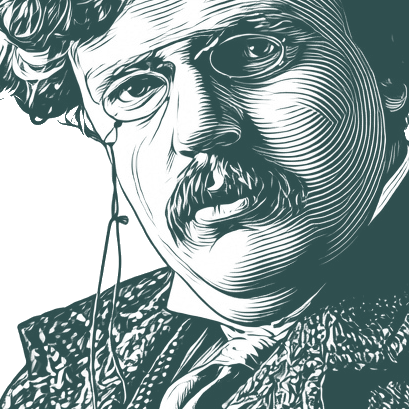
Portrait adapted from
Wikimedia Commons, Ernest Herbert Mills (Public domain / CC0)
Also Known As
Native Name:
Gilbert Keith Chesterton
Alternative Names:
František Kafka
•
Kafka
•
Gilbert K. Chesterton
•
Gilbert Chesterton
•
G.K. Chesterton
•
G. K. C.
People wonder why the novel is the most popular form of literature; people wonder why it is read more than books of science or books of metaphysics. The reason is very simple; it is merely that the novel is more true than they are.
But whenever one meets modern thinkers (as one often does) progressing towards a madhouse, one always finds, on inquiry, that they have just had a splendid escape from another madhouse. Thus, hundreds of people become Socialists, not because they have tried Socialism and found it nice, but because they have tried Individualism and found it nasty.
Enhance Your Quote Experience
Enjoy ad-free browsing, unlimited collections, and advanced search features with Premium.
When Christ at a symbolic moment was establishing His great society, He chose for its cornerstone neither the brilliant Paul nor the mystic John, but a shuffler, a snob, a coward – in a word, a man. And upon this rock He has built His Church, and the gates of Hell have not prevailed against it. All the empires and the kingdoms have failed, because of this inherent and continual weakness, that they were founded by strong men and upon strong men. But this one thing, the historic Christian Church, was founded on a weak man, and for that reason it is indestructible. For no chain is stronger than its weakest link.