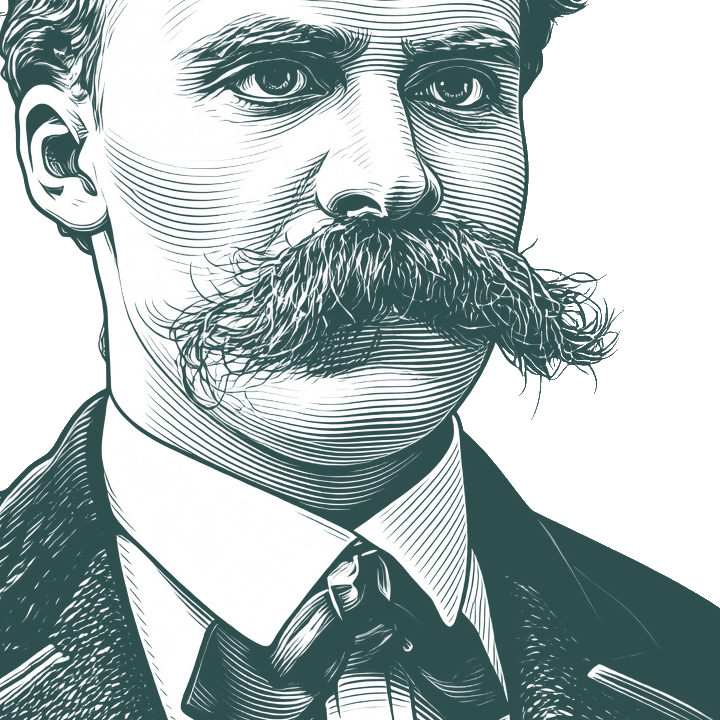
... all life rests on appearance, art, illusion, optics, the need for perspective and for error... - Friedrich Nietzsche
""
... all life rests on appearance, art, illusion, optics, the need for perspective and for error...
English
Collect this quote
About
Friedrich Nietzsche
Friedrich Wilhelm Nietzsche (15 October 1844 – 25 August 1900) was a German philosopher, cultural critic, composer, poet, writer, and philologist whose work has exerted a profound influence on modern intellectual history. His critiques of contemporary culture, religion, and philosophy centered on a basic question regarding the foundation of values and morality.
Biography information from
Wikiquote·
Portrait adapted from
Wikimedia Commons, Friedrich Hermann Hartmann (Public domain / CC0)
Also Known As
Alternative Names:
Friedrich Wilhelm Nietzsche
•
Nietzsche
To demand of strength that it should not express itself as strength, that it should not be a desire to overcome, a desire to throw down, a desire to become master, a thirst for enemies and resistances and triumphs, is just as absurd as to demand of weakness that it should express itself as strength. A quantum of force is equivalent to a quantum of drive, will, effect—more, it is nothing other than precisely this very driving, willing, effecting, and only owing to the seduction of language (and of the fundamental errors of reason that are petrified in it) which conceives and misconceives all effects as conditioned by something that causes effects, by a “subject,” can it appear otherwise. For just as the popular mind separates the lightning from its flash and takes the latter for an action, for the operation of a subject called lightning, so popular morality also separates strength from expressions of strength, as if there were a neutral substratum behind the strong man, which was free to express strength or not to do so. But there is no such substratum; there is no “being” behind doing, effecting, becoming; “the doer” is merely a fiction added to the deed—the deed is everything. The popular mind in fact doubles the deed; when it sees the lightning flash, it is the deed of a deed: it posits the same event first as cause and then a second time as its effect. [..] [O]ur entire science still lies under the misleading influence of language and has not disposed of that little changeling, the “subject” (the atom, for example, is such a changeling, as is the Kantian “thing-in-itself”); no wonder if the submerged, darkly glowering emotions of vengefulness and hatred exploit this belief for their own ends and in fact maintain no belief more ardently than the belief that the strong man is free to be weak and the bird of prey to be a lamb—for thus they gain the right to make the bird of prey accountable for being a bird of prey.
Objection, evasion, joyous distrust, and love of irony are signs of health; everything absolute belongs to pathology.
Limited Time Offer
Premium members can get their quote collection automatically imported into their Quotewise collections.