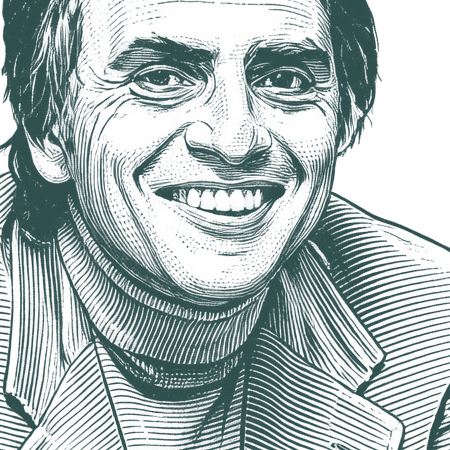
Contrary to the fantasies of the fundamentalists, there was no deathbed conversion, no last minute refuge taken in a comforting vision of heaven or a… - Carl Sagan
""
Contrary to the fantasies of the fundamentalists, there was no deathbed conversion, no last minute refuge taken in a comforting vision of heaven or an afterlife. For Carl, what mattered most was what was true, not merely what would make us feel better. Even at this moment when anyone would be forgiven for turning away from the reality of our situation, Carl was unflinching. As we looked deeply into each other's eyes, it was with a shared conviction that our wondrous life together was ending forever.
English
Collect this quote
About
Carl Sagan
Carl Edward Sagan (9 November 1934 – 20 December 1996) was an American astronomer, planetary scientist, cosmologist, astrophysicist, astrobiologist, author, and science communicator. His best known scientific contribution is research on extraterrestrial life, including experimental demonstration of the production of amino acids from basic chemicals by radiation. Sagan assembled the first physical messages sent into space, the Pioneer plaque and the Voyager Golden Record, universal messages that could potentially be understood by any extraterrestrial intelligence that might find them. Sagan argued the hypothesis, accepted since, that the high surface temperatures of Venus can be attributed to, and calculated using, the greenhouse effect. He testified to the US Congress in 1985 that the greenhouse effect will change the earth's climate system.
Biography information from
Wikiquote·
Portrait adapted from
Wikimedia Commons, NASA/JPL (Public domain / CC0)
Also Known As
Native Name:
Carl Edward Sagan
Alternative Names:
Sagan
•
Carl E. Sagan
•
Carl E Sagan
•
C. E. Sagan
•
C.E. Sagan
•
C E Sagan
•
C. Sagan
•
C Sagan
•
Sagan C
•
Sagan C.
•
Sagan C. E.
•
Sagan CE
A universe that is unknowable is no fit place for a thinking being. The ideal universe for us is one very much like the universe we inhabit.
There is child abuse, and there are such things as repressed memories. But there are also such things as false memories and confabulations, and they are not rare at all. Misrememberings are the rule, not the exception. They occur all the time. They occur even in cases where the subject is absolutely confident - even when the memory is a seemingly unforgettable flashbulb, one of those metaphorical mental photographs.
Try QuoteGPT
Chat naturally about what you need. Each answer links back to real quotes with citations.
When a dog runs,” said the naturalist Jakob von Uexküll, “the dog moves his legs; when a sea urchin runs, the legs move the sea urchin.” 10 But even in humans, thinking is often a subsidiary state of consciousness.