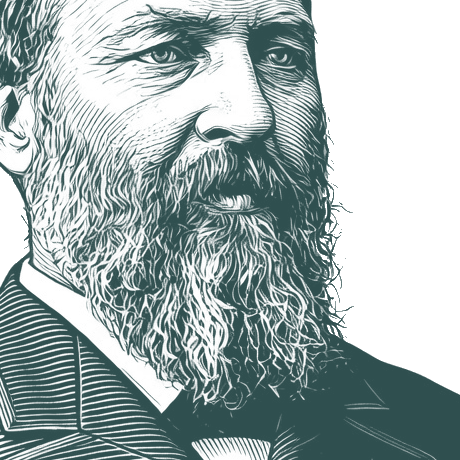
Then your leaders, though holding a majority in the other branch of Congress, were heroic enough to withdraw from their seats and fling down the gage… - James A. Garfield
""
Then your leaders, though holding a majority in the other branch of Congress, were heroic enough to withdraw from their seats and fling down the gage of mortal battle. We called it rebellion; but we recognized it as courageous and manly to avow your purpose, take all the risks, and fight it out in the open field. Notwithstanding your utmost efforts to destroy it, the government was saved. Year by year, since the war ended, those who resisted you have come to believe that you have finally renounced your purpose to destroy, and are willing to maintain the government. In that belief you have been permitted to return to power in the two Houses.
English
Collect this quote
About
James A. Garfield
James Abram Garfield (19 November 1831 – 19 September 1881) was the 20th president of the United States of America in 1881, and the second U.S. president to be assassinated. His term was the second shortest in U.S. history, after William Henry Harrison's. Holding office from March to September of 1881, President Garfield was in office for a total of just six months and fifteen days. A Republican, he supported civil rights and freedoms for African Americans.
Biography information from
Wikiquote·
Portrait adapted from
Wikimedia Commons, Unknown; part of Brady-Handy Photograph Collection. (Public domain / CC0)
Also Known As
Birth Name:
James Abram Garfield
Alternative Names:
James Garfield
•
J. A. Garfield
•
J. Garfield
•
President Garfield
During the war of the Revolution, and in 1788, the date of the adoption of our national Constitution, there was but one State among the thirteen whose constitution refused the right of suffrage to the negro. That State was South Carolina. Some, it is true, established a property qualification; all made freedom a prerequisite; but none save South Carolina made color a condition of suffrage. The Federal Constitution makes no such distinction, nor did the Articles of Confederation. In the Congress of the Confederation, on the 25th of June, 1778, the fourth article was under discussion. It provided that 'the free inhabitants of each of these States — paupers, vagabonds, and fugitives from justice excepted — shall be entitled to all privileges and immunities of free citizens in the several States.' The delegates from South Carolina moved to insert between the words 'free inhabitants' the word 'white', thus denying the privileges and immunities of citizenship to the colored man. According to the rules of the convention, each State had but one vote. Eleven States voted on the question. One was divided; two voted aye; and eight voted no. It was thus early, and almost unanimously, decided that freedom, not color, should be the test of citizenship.
The colonists were struggling not only against the armies of a great nation, but against the settled opinions of mankind; for the world did not then believe that the supreme authority of government could be safely intrusted to the guardianship of the people themselves. We can not overestimate the fervent love of liberty, the intelligent courage, and the sum of common sense with which our fathers made the great experiment of self-government. When they found, after a short trial, that the confederacy of States, was too weak to meet the necessities of a vigorous and expanding republic, they boldly set it aside, and in its stead established a National Union, founded directly upon the will of the people, endowed with full power of self-preservation and ample authority for the accomplishment of its great object.
PREMIUM FEATURE
Advanced Search Filters
Filter search results by source, date, and more with our premium search tools.
We do not even inquire whether a black man is a rebel in arms, or not, if he is black, be he friend or foe, he is thought best kept at a distance. It is hardly possible God will let us succeed while such enormities are practiced.