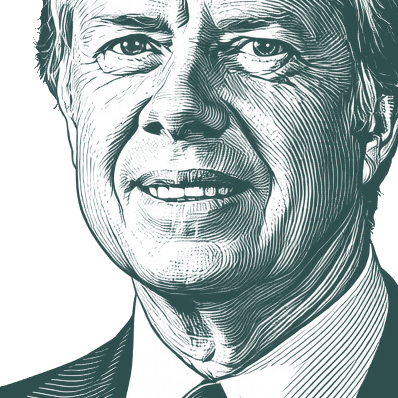
Theologian Paul Tillich maintained that there is a profound difference between anxiety and fear. Anxiety, he wrote, grows out of the awareness of our… - Jimmy Carter

" "

Theologian Paul Tillich maintained that there is a profound difference between anxiety and fear. Anxiety, he wrote, grows out of the awareness of our own fragility, uncertainty, and impending death. By contrast, fear is of a specific, identifiable threat or object that can be faced or endured with courage. Tillich said that we should strive to change overwhelming anxiety into fear, with which we may deal more effectively. Our guilt and anxiety are relieved when we realize that God has already accepted us and loves us as we are.

English
Collect this quote

About Jimmy Carter

James Earl Carter, Jr. (October 1, 1924 – December 29, 2024) was an American politician and member of the Democratic Party who served as the 39th president of the United States from 1977 to 1981. In 1982 he established the Carter Center, as a base for promoting human rights, democracy, finding peaceful solutions to international conflicts, and advancing economic and social development, for which he was awarded the Nobel Peace Prize in 2002. He was a key figure in the Habitat for Humanity project, and has been noted for his criticism of Israel's role in the Israeli–Palestinian conflict.

Biography information from Wikiquote

Also Known As

Birth Name: James Earl Carter Jr.
Alternative Names: James E. Carter James Carter James Earl Carter 39th President of the United States James E. Carter Jr. James Earl Carter, Jr. James E. Carter, Jr.
PREMIUM FEATURE
Advanced Search Filters

Filter search results by source, date, and more with our premium search tools.

Related quotes. More quotes will automatically load as you scroll down, or you can use the load more buttons.

Additional quotes by Jimmy Carter

For too long, handicapped people have been deprived of a right to an education. For too long, handicapped people have been excluded from the possibility of jobs and employment where they could support themselves. For too long, handicapped people have been kept out of buildings, have been kept off of streets and sidewalks, have been excluded from private and public transportation, and have been deprived of a simple right in many instances just to communicate with one another. When I was inaugurated Governor of Georgia in January of 1971, I made a speech. And I said, in that southern State the time for racial discrimination is over. And I say to you tonight the time for discrimination against the handicapped in the United States is over. [Applause] Thank you very much. It would be a mistake for the rest of America to think that the benefits are only going to the handicapped, because when you get freedom, we share that freedom, and when the handicapped get benefits of education and a job and a purposeful life, we all share in the benefits of that education, that job, and a purposeful life.

We have, in the whole country, now brought the unemployment rate down, I'd say, about 1 percent below what it was a year ago. And as you've already heard, in Detroit itself in the last 2 or 3 years, the unemployment rate has dropped about 75 percent. But that still means that when you have a 6 or 7 percent unemployment rate nationwide among young men like you, who are black, who have a fairly good education even, the unemployment rate runs 35 or 40 percent, which is entirely too high. What we have tried to do already-and I would say the Congress has cooperated--is to concentrate our efforts on the Comprehensive Education and Training Act among young people themselves. We are now building up those jobs to 725,000. It will take a while to get up to that level. We are adding about, I'd say, in that particular program about 15,000 new jobs per week, which is a fairly big increase. About half those jobs will go to minority young people. In addition, we've got a $1 1/2 billion youth employment bill that the Congress passed, ! signed into law. This has been within the last month or so. And it's just beginning to be put into effect. Another thing that will help you is that in the public works projects that will be built in your area--and we're concentrating them more and more not in the wealthy suburban areas, but in the downtown areas where the need is greatest--at least 10 percent of those contracts in the future must go to minority business enterprises, and we're trying to make sure that the business is actually owned by a minority and not owned by the majority with just a figurehead black person whose name is used to qualify for the funds themselves. Another thing that I'd like to point out to you is this: We've got a better economy than most of the nations of the world, but we've still got a long way to go. My goal, already established, is that before this term of mine is over that we'll bring that unemployment rate down from 8 percent, which it was last December, to well under 5 percent by the time 1981 rolls around. There are not any automatic or easy answers. It's a very tough proposition. But the only thing we can do is make sure the jobs are made available in private industry, first of all, in government, second of all, and to make sure that the discrimination that has existed in the past against minority young people like you is wiped away and that we give 'a first priority in all our programs to the areas of the Nation, the areas of cities that have been hurt the worst. All those things are of substantial change or improvement over what we've seen in the past. But it's going to be a hard, long, tough proposition, and I wish you well.

Limited Time Offer

Premium members can get their quote collection automatically imported into their Quotewise collections.

The revelations about October's balance-of-trade deficit were quite disturbing. We analyzed this and found that the same monthly rate of deficit that had existed ever since last May or June, about $2.4 billion per month, is exactly the average of September and October. So, we apparently have a fairly stable pattern per month of a $2.4 billion deficit, primarily caused by two factors: One is our extraordinary importation of foreign oil. We import $3.7 billion worth of oil every month. This means that we have, if we didn't import the oil, about a $15 billion trade surplus per year. And we have got to cut down on the excessive importing of oil from overseas before we can hope to get our trade balanced. The other reason for an adverse balance is that our own economy has improved in the last few years--few months, much more than has the rest of the world. Because of our improvement in the economy, we are much more able to buy and much more willing to buy goods from overseas than those nations are able to buy from us because their economies have not been restored as much as ours. We have one major element that can be introduced to cut down on our trade deficits-and that's obvious--and that is to reduce oil imports.

Loading...