Experience proved that man's power of choice in action was very far from absolute, and logic seemed to require that every choice should have some pre… - Henry Adams
""
Experience proved that man's power of choice in action was very far from absolute, and logic seemed to require that every choice should have some predetermining cause which decided the will to act. Science affirmed that choice was not free,— could not be free,— without abandoning the unity of force and the foundation of law. Society insisted that its choice must be left free, whatever became of science or unity. Saint Thomas was required to illustrate the theory of liberum arbitrium by choosing a path through these difficulies, where path there was obviously none.
English
Collect this quote
About
Henry Adams
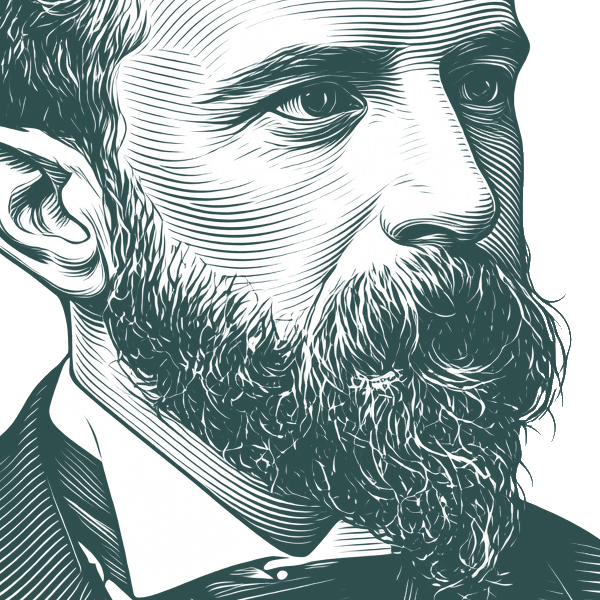
Henry Brooks Adams (16 February 1838 – 27 March 1918) was a U.S. historian, journalist, novelist and educator. He was the great-grandson of John Adams, grandson of John Quincy Adams and son of Charles Francis Adams, Sr.
Biography information from
Wikiquote·
Portrait adapted from
Wikimedia Commons, William Notman (Public domain / CC0)
Susceptibility to the highest forces is the highest genius; selection between them is the highest science; their mass is the highest educator. Man always made, and still makes, grotesque blunders in selecting and measuring forces, taken at random from the heap, but he never made a mistake in the value he set on the whole, which he symbolized as unity and worshipped as God.
Then came the journey up to London through Birmingham and the Black District, another lesson, which needed much more to be rightly felt. The plunge into darkness lurid with flames; the sense of unknown horror in this weird gloom which then existed nowhere else, and never had existed before, except in volcanic craters; the violent contrast between this dense, smoky, impenetrable darkness, and the soft green charm that one glided into, as one emerged — the revelation of an unknown society of the pit — made a boy uncomfortable, though he had no idea that Karl Marx was standing there waiting for him, and that sooner or later the process of education would have to deal with Karl Marx much more than with Professor Bowen of Harvard College or his Satanic free-trade majesty John Stuart Mill. The Black District was a practical education, but it was infinitely far in the distance. The boy ran away from it, as he ran away from everything he disliked.
The two men would have disliked each other by instinct had they lived in different planets. Each was created only for exasperating the other; the virtues of one were the faults of his rival, until no good quality seemed to remain of either.