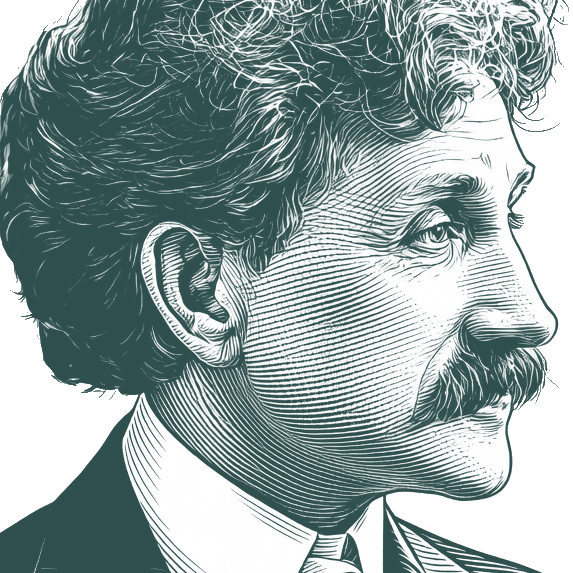
The world we inhabit is not an ideal world, except to the ninny. It is not such a world as we would pick out if we were choosing, unless the assortme… - J. Howard Moore
""
The world we inhabit is not an ideal world, except to the ninny. It is not such a world as we would pick out if we were choosing, unless the assortment from which we were to make the selection were a pretty hard batch. It is so full of inconveniences in the first place—so much so that it seems sometimes that it must have been whittled out in some idle hour, without any idea that it would ever be used for anything, and then, when organic beings came into existence, it was given to them as a place to grow up and fight it out in, because there wasn't any other place for them to go. Then, again, it is inhabited by a lot of species that have acquired their natures through an apprenticeship of crime and militancy extending bade millions of years into the past.
John Howard Moore (December 4, 1862 – June 17, 1916) was an American zoologist, philosopher, educator and social reformer. He advocated for the ethical consideration and treatment of animals and authored several articles, books, essays and pamphlets on topics including education, ethics, evolutionary biology, humanitarianism, utilitarianism and vegetarianism. He is best known for his work The Universal Kinship (1906), which advocated for a secular sentiocentric philosophy he called the doctrine of "Universal Kinship", based on the shared evolutionary kinship between all sentient beings.
[T]he difference in mental method between the man of learning and the ordinary man or woman is the same as the difference between mature men and children and between men generally and other animals. It is one of degree, not of kind. The philosopher, the clodhopper, and the ape, all use precisely the same methods of reasoning, differing only in exactness and in the materials of consciousness dealt with.
The inextricable way pleasure and pain are mixed up with each other in this world is a mournful fact to beings who are all the time striving for pleasure alone. In the ideal world there is no pain, no misery. There is nothing but happiness. But in our world pain seems to have been the original feeling, the first one to appear in the evolution of sentiency. Pleasure is a sort of after-thought, a secondary attribute of consciousness which developed later as an aid to pain in keeping living beings straight. Pain is a whip, a penalty. Pleasure is a reward or bribe. Pain is a curse. We are all the time trying to minimize and escape it. In an ideal world the inhabitants never have any impulses that drive them to improper acts. All their impulses are good. Every act is proper and right. Ideal beings need only to live and act in order to be happy. We are not ideal beings. Our world happens to be one affording almost unlimited opportunities for improvement.
The dread of death, an instinct so unfailing in all animals, exists, not because existence is intrinsically so sweet, nor because annihilation is so distressing, but because this bugaboo has been an indispensable safeguard against the suicide of the life process. The expectation of post-mortem consciousness, so prevalent and so insistent among human beings, is a hope arising from the concussion of a desire and a fancy—the desire to persist just referred to, and the fancy or hallucination of a double which originated among savages from shadows, images, dreams, and the like.