It is well sometimes to half understand a poem in the same manner that we half understand the world. - G. K. Chesterton
""
It is well sometimes to half understand a poem in the same manner that we half understand the world.
English
Collect this quote
About
G. K. Chesterton
Gilbert Keith Chesterton (29 May 1874 – 14 June 1936) was a British writer whose prolific and diverse output included works of philosophy, ontology, poetry, play writing, journalism, public lecturing and debating, literary and art criticism, biography, Christian apologetics (particularly for Catholicism), and fiction, including fantasy and detective fiction. He has been called the "prince of paradox".
Biography information from
Wikiquote·
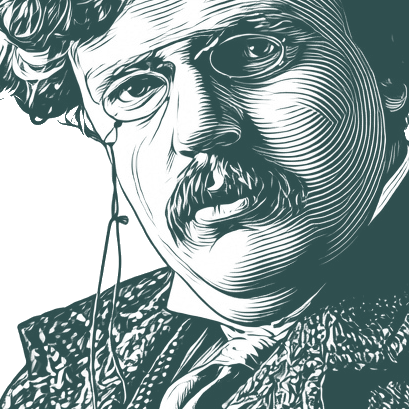
Portrait adapted from
Wikimedia Commons, Ernest Herbert Mills (Public domain / CC0)
Also Known As
Native Name:
Gilbert Keith Chesterton
Alternative Names:
František Kafka
•
Kafka
•
Gilbert K. Chesterton
•
Gilbert Chesterton
•
G.K. Chesterton
•
G. K. C.
There are two ways of getting home; and one of them is to stay there.
Fairy tales, then, are not responsible for producing in children fear, or any of the shapes of fear; fairy tales do not give the child the idea of the evil or the ugly; that is in the child already, because it is in the world already. Fairy tales do not give the child his first idea of bogey. What fairy tales give the child is his first clear idea of the possible defeat of bogey. The baby has known the dragon intimately ever since he had an imagination. What the fairy tale provides for him is a St. George to kill the dragon. Exactly what the fairy tale does is this: it accustoms him for a series of clear pictures to the idea that these limitless terrors had a limit, that these shapeless enemies have enemies in the knights of God, that there is something in the universe more mystical than darkness, and stronger than strong fear.
PREMIUM FEATURE
Advanced Search Filters
Filter search results by source, date, and more with our premium search tools.
No man encouraged his characters so much as Dickens. "I am an affectionate father," he says, "to every child of my fancy." He was not only an affectionate father, he was an overindulgent father. The children of his fancy are spoilt children. They shake the house like heavy and shouting schoolboys; they smash the story to pieces like so much furniture.