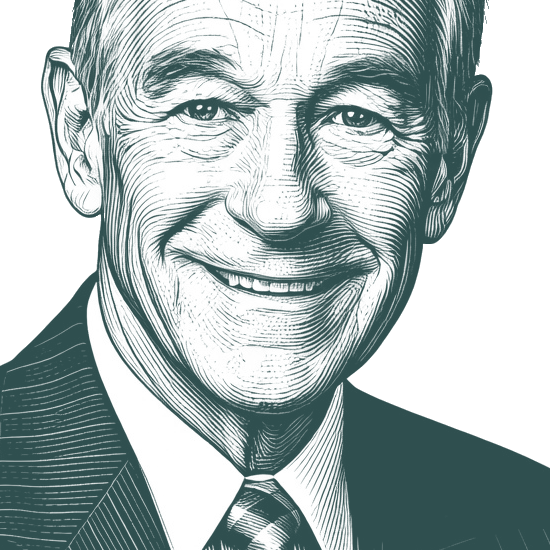
Ronald Ernest "Ron" Paul (born 20 August 1935) is an American author, activist, physician, and retired politician who served as the U.S. representative for Texas's 22nd congressional district from 1976 to 1977 and again from 1979 to 1985, and then for Texas's 14th congressional district from 1997 to 2013. On three occasions, he sought the presidency of the United States: as the Libertarian Party nominee in 1988 and as a candidate for the Republican Party in 2008 and 2012. A self-described constitutionalist, Paul is a critic of the federal government's fiscal policies, especially the existence of the Federal Reserve and the tax policy, as well as the military–industrial complex, the war on drugs, and the war on terror. He has also been a vocal critic of mass surveillance policies such as the USA PATRIOT Act and the NSA surveillance programs. In 1976, Paul formed the Foundation for Rational Economics and Education (FREE), and in 1985 was named the first chairman of the conservative PAC Citizens for a Sound Economy, both free-market groups focused on limited government. He is the father of Senator Rand Paul.
Portrait adapted from
Wikimedia Commons, United States Congress (Public domain / CC0)
Also Known As
Alternative Names:
Ronald Ernest "Ron" Paul
•
Ronald Ernest Paul
•
Ronald Paul
We quadrupled the TSA, you know, and hired more people who look more suspicious to me than most Americans who are getting checked. Most of them, they just don't look very American to me. If I'd have been looking, they look suspicious.… I mean, a lot of them can't even speak English, hardly. Not that I'm accusing them of anything, but it's sort of ironic.
We are escalating our sharp rhetoric toward Iran, we're deploying additional carrier group and Patriot missiles to the region. And, although Iran has approached the United States to establish serious dialog two times since 9/11, they have been rebuffed both times... Condoleezza Rice: ...When we have a carrier strike group into the gulf, or provide PAC-3, which is a defensive system, it's simply to demonstrate that the United States remains determined to defend its interests in the gulf, and the interests of its allies. And that, congressman, is a position that has been held by American presidents going back for nearly 60 years. I would just note that these are discrete responses to Iranian activities that are really deeply concerning, not just for us, but for the rest of the world as well. Now as to Tehran, and whether we can talk to them. I offered in May to reverse 27 years of American policy, and to meet my counterpart any place, any time, to talk about any set of issues that Iran wishes to talk about, if they would just do one thing. And that is, adhere to the demand that the international community is making, that they stop enrichment and reprocessing, so that we that while we're talking, they're not improving their capability to get a nuclear weapon. So I think, congressman, the question isn't why won't we talk to Tehran, the question is why won't they talk to us.
Unlimited Quote Collections
Organize your favorite quotes without limits. Create themed collections for every occasion with Premium.
Secretary of State Mike Pompeo's rush to judgement that Iran was behind the apparent attacks on two tanker ships last week has not galvanized world opinion against Iran, as the neocons hoped. Instead, it was met with high skepticism even among Washington's closest allies. Has the neocon practice of massively exaggerating and endlessly issuing threats finally destroyed US credibility on the world stage?