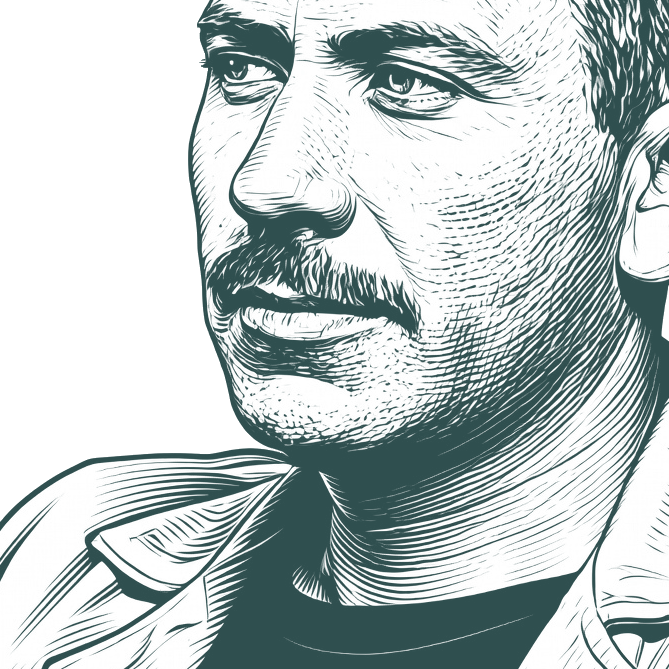
John Ernst Steinbeck Jr. (27 February 1902 – 20 December 1968) was an American writer. A recipient of the Nobel Prize for Literature in 1962, his works include the novella Of Mice and Men (1937) and the novel The Grapes of Wrath (1939, Pulitzer Prize for Fiction, 1940), both of which examine the lives of the working class and migrant workers during the Great Depression.
Biography information from
Wikiquote·
Portrait adapted from
Wikimedia Commons, McFadden Publications, Inc.; no photographer credited; photo likely the work of Sonya Noskowiak, as Steinbeck is wearing the same clothes from her 1935 studio session that produced the work shown here: https://www.si.edu/object/npg_NPG.2006.74 (Public domain / CC0)
Also Known As
Birth Name:
Jeffery Ernest Steinbeck
Alternative Names:
John Ernst Steinbeck, Jr.
•
John Ernst Steinbeck
•
John Ernest Steinbeck
•
John Ernst Steinbeck Jr
•
Steinbeck
Portrait from Wikimedia Commons. Credit: McFadden Publications, Inc.; no photographer credited; photo likely the work of Sonya Noskowiak, as Steinbeck is wearing the same clothes from her 1935 studio session that produced the work shown here: https://www.si.edu/object/npg_NPG.2006.74. Used under Public domain / CC0. Processed and styled by Quotewise.
Works in ChatGPT, Claude, or Any AI
Add semantic quote search to your AI assistant via MCP. One command setup.
"Pa said, "Won't you say a few words? Ain't none of our folks ever been buried without a few words." Connie led Rose of Sharon to the graveside, she reluctant. "You got to," Connie said. "It ain't decent not to. It'll jus' be a little. The firelight fell on the grouped people, showing their faces and their eyes, dwindling on their dark clothes.All the hats were off now. The light danced, jerking over the people. Casy said, It'll be a short one." He bowed his head, and the others followed his lead. Casy said solemnly, "This here ol' man jus' lived a life an' just died out of it. I don't know whether he was good or bad, but that don't matter much. He was alive, an' that's what matters. An' now his dead, an' that don't matter. Heard a fella tell a poem one time, an' he says 'All that lives is holy.' Got to thinkin', an' purty soon it means more than the words says. An' I woundn' pray for a ol' fella that's dead. He's awright. He got a job to do, but it's all laid out for'im an' there's on'y one way to do it. But us, we got a job to do, an' they's a thousan' ways, an' we don' know which one to take. An' if I was to pray, it'd be for the folks that don' know which way to turn. Grampa here, he got the easy straight. An' now cover 'im up and let'im get to his work." He raised his head."
It occurs to me that just as the Carthaginians hired mercenaries to do their fighting for them, we Americans being in mercenaries to do our hard and humble work. I hope we may not be overwhelmed one day by peoples not too proud or too lazy or too soft to bend to the earth and pick up the things we eat.
He can kill anything for need but he could not even hurt a feeling for pleasure.