The apportionment of taxes on the various descriptions of property is an act which seems to require the most exact impartiality; yet there is, perhap… - James Madison
""
The apportionment of taxes on the various descriptions of property is an act which seems to require the most exact impartiality; yet there is, perhaps, no legislative act in which greater opportunity and temptation are given to a predominant party to trample on the rules of justice. Every shilling which they overburden the inferior number is a shilling saved to their own pockets.
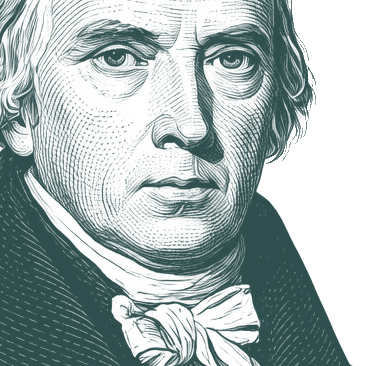
James Madison Jr. (16 March 1751 – 28 June 1836) was an American statesman, diplomat, and Founding Father who served as the fourth president of the United States from 1809 to 1817. Madison was popularly acclaimed the "Father of the Constitution" for his pivotal role in drafting and promoting the Constitution of the United States and the Bill of Rights.
Biography information from
Wikiquote·
Portrait adapted from
Wikimedia Commons, John Vanderlyn (Public domain / CC0)
Also Known As
Birth Name:
James Madison, Jr.
Alternative Names:
James Madison Jr.
•
President Madison
•
President James Madison
I cannot undertake to lay my finger on that article of the Constitution which granted a right to Congress of expending, on objects of benevolence, the money of their constituents.
Man who preys both on the vegetable and animal species, is himself a prey to neither. He too possesses the reproductive principle far beyond the degree requisite for the bare continuance of his species. What becomes of the surplus of human life to which this principle is competent? It is either, 1st. destroyed by infanticide, as among the Chinese and Lacedemonians; or 2d. it is stifled or starved, as among other nations whose population is commensurate to its food; or 3d. it is consumed by wars and endemic diseases; or 4th. it overflows, by emigration, to places where a surplus of food is attainable.
Limited Time Offer
Premium members can get their quote collection automatically imported into their Quotewise collections.
During almost fifteen centuries has the legal establishment of Christianity been on trial. What have been its fruits? More or less in all places, pride and indolence in the Clergy, ignorance and servility in the laity, in both, superstition, bigotry and persecution.