<small>For further information on this essay see also John R. Vile (2009): Detached Memoranda. In: The First Amendment Encyclopedia presented by the … - James Madison
""
<small>For further information on this essay see also John R. Vile (2009): Detached Memoranda. In: The First Amendment Encyclopedia presented by the John Seigenthaler Chair of Excellence in First Amendment Studies. Archived from the original on August 3, 2020. Retrieved on August 3, 2020.</small>
English
Collect this quote
About
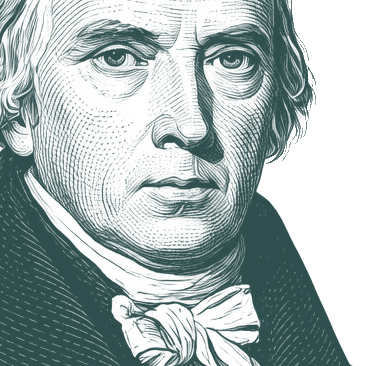
James Madison
James Madison Jr. (16 March 1751 – 28 June 1836) was an American statesman, diplomat, and Founding Father who served as the fourth president of the United States from 1809 to 1817. Madison was popularly acclaimed the "Father of the Constitution" for his pivotal role in drafting and promoting the Constitution of the United States and the Bill of Rights.
Biography information from
Wikiquote·
Portrait adapted from
Wikimedia Commons, John Vanderlyn (Public domain / CC0)
Also Known As
Birth Name:
James Madison, Jr.
Alternative Names:
James Madison Jr.
•
President Madison
•
President James Madison
Because finally, “the equal right of every citizen to the free exercise of his religion according to the dictates of conscience” is held by the same tenure with all his other rights. If we recur to its origin, it is equally the gift of nature; if we weigh its importance, it cannot be less dear to us; if we consider “the declaration of those rights which pertain to the good people of Virginia as the basis and foundation of government,” it is enumerated with equal solemnity, or rather studied emphasis.
But what is government itself but the greatest of all reflections on human nature.
Go Premium
Support Quotewise while enjoying an ad-free experience and premium features.
A pure Democracy, by which I mean a Society consisting of a small number of citizens, who assemble and administer the Government in person, can admit of no cure for the mischiefs of faction. A common passion or interest will, in almost every case, be felt by a majority of the whole; a communication and concert result from the form of Government itself; and there is nothing to check the inducements to sacrifice the weaker party, or an obnoxious individual. Hence it is, that such Democracies have ever been spectacles of turbulence and contention; have ever been found incompatible with personal security, or the rights of property; and have in general been as short in their lives, as they have been violent in their deaths. Theoretic politicians, who have patronized this species of Government, have erroneously supposed, that by reducing mankind to a perfect equality in their political rights, they would, at the same time, be perfectly equalized and assimilated in their possessions, their opinions, and their passions.