Let not thy winged days be spent in vain. When once gone, no gold can buy them back.’ It meant that the best days of our lives were now, when we were… - A. P. J. Abdul Kalam
""
Let not thy winged days be spent in vain. When once gone, no gold can buy them back.’ It meant that the best days of our lives were now, when we were learning, and we had to make the most of this time. Once gone, the time would run like sand between our fingers and we would never get it back again. The words filled me with hope and expectations and also helped me put aside my homesickness and look forward to all that I would learn at this new school.
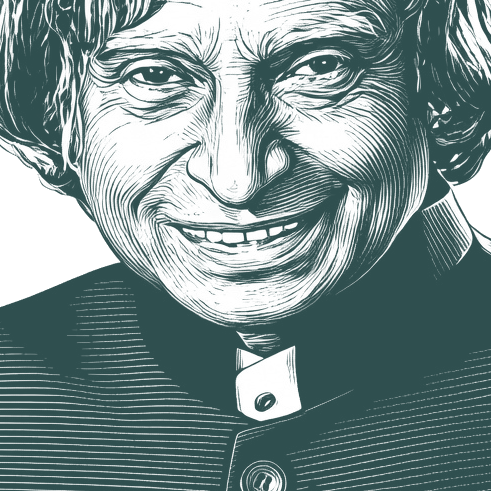
Avul Pakir Jainulabdeen Abdul Kalam (15 October 1931 – 27 July 2015) was an Indian aerospace scientist who served as the 11th president of India from 2002 to 2007. He was born and raised in Rameswaram, Tamil Nadu and studied physics and aerospace engineering.
Biography information from
Wikiquote·
Portrait adapted from
Wikimedia Commons, Government of India (CC BY)
Also Known As
Native Name:
Avul Pakir Jainulabdeen Abdul Kalam
•
डॉक्टर अवुल पकिर जैनुलाब्दीन अब्दुल कलाम
•
அவுல் பகிர் ஜைனுலாப்தீன் அப்துல் கலாம்
Alternative Names:
Abdul Kalam
•
Kalam
•
A.P.J Abdul Kalam
•
A P J Abdul Kalam
•
Abul Pakiz Jainulabdeen Abdul Kalam
•
APJ Abdul Kalam
•
Dr APJ Abdul Kalam
•
APJ
The knowledge society has two very important components driven by societal transformation and wealth generation. The societal transformation is with respect to education, healthcare, agriculture and governance. These will lead to employment generation, high productivity and rural prosperity.
Dream is not what we see in sleep, dream is what that does not allow us to sleep..
Go Premium
Support Quotewise while enjoying an ad-free experience and premium features.
We conducted research on the competencies and development requirements of each state. The required information was collected from the Planning Commission, government departments — both central and state — national and international assessments of the state and other relevant documents. The data was analysed and put in a presentable form using graphics and multimedia. At the meetings, PowerPoint presentations were made to the MPs with an emphasis on three areas: 1) the vision for a developed India; 2) the heritage of the particular states or union territory; and 3) their core competencies. The objective was to stress the point that to achieve the development of the nation, it was vital to achieve the development of each of these areas. Hence a fourth aspect was also prepared — selected development indicators for each of them. And what an enrichment I got by way of preparation and by the contributions of the members of Parliament, who hailed from all parties. Meeting them helped me to understand the richness of the diverse parts of the country.