My fiftieth year had come and gone,
I sat, a solitary man,
In a crowded London shop,
An open book and empty cup
On the marble table-top.
While on th… - William Butler Yeats
""
My fiftieth year had come and gone, I sat, a solitary man, In a crowded London shop, An open book and empty cup On the marble table-top.
While on the shop and street I gazed My body of a sudden blazed; And twenty minutes more or less It seemed, so great my happiness, That I was blessed and could bless.
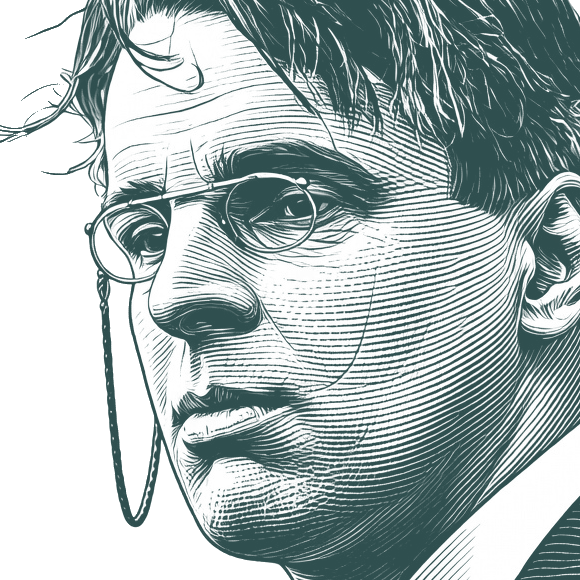
William Butler Yeats (13 June 1865 – 28 January 1939) was an Irish symbolist poet, dramatist and mystic. He was awarded the Nobel Prize for Literature in 1923. He compiled the Oxford Book of Modern Verse.
Biography information from
Wikiquote·
Portrait adapted from
Wikimedia Commons, George Charles Beresford (Public domain / CC0)
Also Known As
Alternative Names:
W. B. Yeats
•
William Yeats
•
W.B. Yeats
•
WBY
The fascination of what's difficult has dried the sap out of my veins and rent spontaneous joy and natural content out of my heart.
Labour is blossoming or dancing where The body is not bruised to pleasure soul. Nor beauty born out of its own despair, Nor blear-eyed wisdom out of midnight oil. O chestnut-tree, great-rooted blossomer, Are you the leaf, the blossom or the bole? O body swayed to music, O brightening glance, How can we know the dancer from the dance?
Try QuoteGPT
Chat naturally about what you need. Each answer links back to real quotes with citations.
TO HIS HEART, BIIDING IT HAVE NO FEAR
Be you still, be you still, trembling heart; Remember the wisdom out of the old days: Him who trembles before the flame and the flood, And the winds that blow through the starry ways, Let the starry winds and the flame and the flood Cover over and hide, for he has no part With the lonely, majestical multitude.
THE CAP AND THE BELLS
The jester walked in the garden: The garden had fallen still; He bade his soul rise upward And stand on her window-sill. It rose in a straight blue garment, When owls began to call: It had grown wise-tongued by thinking Of a quiet and light footfall; But the young queen would not listen; She rose in her pale night-gown; She drew in the heavy casement And pushed the latches down. He bade his heart go to her, When the owls called out no more; In a red and quivering garment It sang to her through the door. It had grown sweet-tongued by dreaming Of a flutter of flower-like hair; But she took up her fan from the table And waved it off on the air. 'I have cap and bells,' he pondered, 'I will send them to her and die'; And when the morning whitened He left them where she went by. She laid them upon her bosom, Under a cloud of her hair, And her red lips sang them a love-song Till stars grew out of the air. She opened her door and her window, And the heart and the soul came through, To her right hand came the red one, To her left hand came the blue. They set up a noise like crickets, A chattering wise and sweet, And her hair was a folded flower And the quiet of love in her feet.