Is the appointment of Chaplains to the two Houses of Congress consistent with the Constitution, and with the pure principle of religious freedom? In … - James Madison
""
Is the appointment of Chaplains to the two Houses of Congress consistent with the Constitution, and with the pure principle of religious freedom? In strictness the answer on both points must be in the negative. The Constitution of the U. S. forbids everything like an establishment of a national religion. The law appointing Chaplains establishes a religious worship for the national representatives, to be performed by Ministers of religion, elected by a majority of them; and these are to be paid out of the national taxes. Does not this involve the principle of a national establishment, applicable to a provision for a religious worship for the Constituent as well as of the representative Body, approved by the majority, and conducted by Ministers of religion paid by the entire nation. The establishment of the chaplainship to Congs is a palpable violation of equal rights, as well as of Constitutional principles: The tenets of the chaplains elected [by the majority] shut the door of worship agst the members whose creeds & consciences forbid a participation in that of the majority. To say nothing of other sects, this is the case with that of Roman Catholics & Quakers who have always had members in one or both of the Legislative branches. Could a Catholic clergyman ever hope to be appointed a Chaplain? To say that his religious principles are obnoxious or that his sect is small, is to lift the evil at once and exhibit in its naked deformity the doctrine that religious truth is to be tested by numbers. or that the major sects have a right to govern the minor.
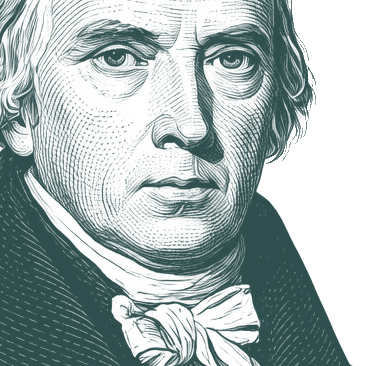
James Madison Jr. (16 March 1751 – 28 June 1836) was an American statesman, diplomat, and Founding Father who served as the fourth president of the United States from 1809 to 1817. Madison was popularly acclaimed the "Father of the Constitution" for his pivotal role in drafting and promoting the Constitution of the United States and the Bill of Rights.
Biography information from
Wikiquote·
Portrait adapted from
Wikimedia Commons, John Vanderlyn (Public domain / CC0)
Also Known As
Birth Name:
James Madison, Jr.
Alternative Names:
James Madison Jr.
•
President Madison
•
President James Madison
The character of such a government ought to secure, first, against foreign invasion; secondly, against dissensions between members of the Union, or seditions in particular States; thirdly, to procure to the several States various blessings of which an isolated situation was incapable; fourthly, it should be able to defend itself against encroachment; and fifthly, to be paramount to the State Constitutions.
As the people are the only legitimate fountain of power, and it is from them that the constitutional charter, under which the several branches of government hold their power, is derived, it seems strictly consonant to the republican theory, to recur to the same original authority, not only whenever it may be necessary to enlarge, diminish, or new-model the powers of the government, but also whenever any one of the departments may commit encroachments on the chartered authorities of the others.
In order to judge of the form to be given to this institution, it will be proper to take a view of the ends to be served by it. These were, — first, to protect the people against their rulers, secondly, to protect the people against the transient impressions into which they themselves might be led.