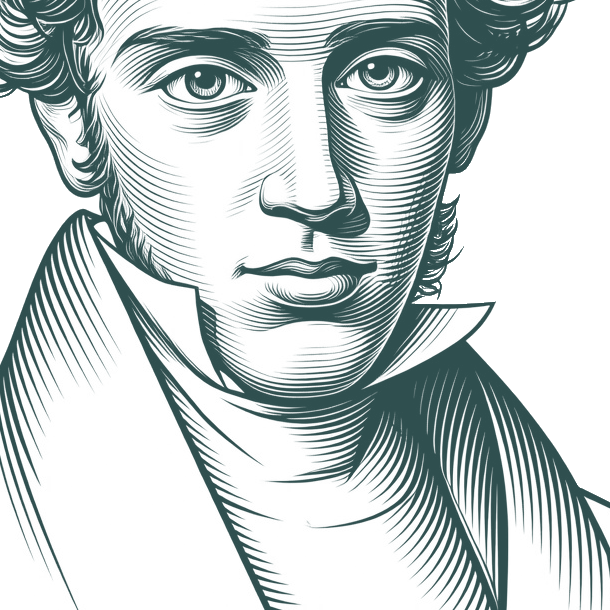
It is modest of the nightingale not to require anyone to listen to it; but it is also proud of the nightingale not to care whether any one listens to… - Søren Kierkegaard
""
It is modest of the nightingale not to require anyone to listen to it; but it is also proud of the nightingale not to care whether any one listens to it or not.
Søren Aabye Kierkegaard (5 May 1813 – 11 November 1855) was a Danish Christian philosopher and theologian, considered to be a founder of Existentialist thought and Absurdist traditions. He wrote critical texts on organized religion, Christendom, morality, ethics, psychology and philosophy of religion, displaying a fondness for metaphor, irony and parables.
Biography information from
Wikiquote·
Portrait adapted from
Wikimedia Commons, La Biblioteca Real de Dinamarca (Public domain / CC0)
Also Known As
Pen Names:
Victor Eremita
•
A
•
Judge William
•
Johannes de silentio
•
Constantine Constantius
•
Young Man
•
Vigilius Haufniensis
•
Nicolaus Notabene
•
Hilarius Bookbinder
•
Johannes Climacus
•
Inter et Inter
•
H.H.
•
Anti-Climacus
•
B
•
Johannes de Silentio
•
Constantin Constantius
•
P. CH. Kierkegaard
Native Name:
Søren Aabye Kierkegaard
Alternative Names:
Kierkegaard
•
Climacus
•
Sören Aaby Kierkegaard
But one must not think ill of the paradox, for the paradox is the passion of thought, and the thinker without the paradox is like the lover without passion: a mediocre fellow.
And so when the generation, which itself desired to level and to be emancipated, to destroy authority and at the same time itself, has, through the scepticism of the principle association, started the hopeless forest fire of abstraction; when as a result of levelling with this scepticism, the generation has rid itself of the individual and of everything organic and concrete, and put in its place 'humanity' and the numerical equality of man and man: when the generation has, for a moment, delighted in this unlimited panorama of abstract infinity, unrelieved by even the smallest eminence, undisturbed by even the slightest interest, a sea of desert; then the time has come for work to begin, for every individual must work for himself, each for himself. No longer can the individual, as in former times, turn to the great for help when he grows confused. That is past; he is either lost in the dizziness of unending abstraction or saved for ever in the reality of religion. Perhaps very many will cry out in despair, but it will not help them — already it is too late...Nor shall any of the unrecognizable presume to help directly or to speak directly or to teach directly at the head of the masses, in order to direct their decisions, instead of giving his negative support and so helping the individual to make the decision which he himself has reached; any other course would be the end of him, because he would be indulging in the short-sighted compassion of man, instead of obeying the order of divinity, of an angry, yet so merciful, divinity. For the development is, in spite of everything, a progress because all the individuals who are saved will receive the specific weight of religion, its essence at first hand, from God himself. Then it will be said: 'behold, all is in readiness, see how the cruelty of abstraction makes the true form of worldliness only too evident, the abyss of eternity opens before you, the sharp scythe of the leveller makes it possible for every one individua
Go Premium
Support Quotewise while enjoying an ad-free experience and premium features.