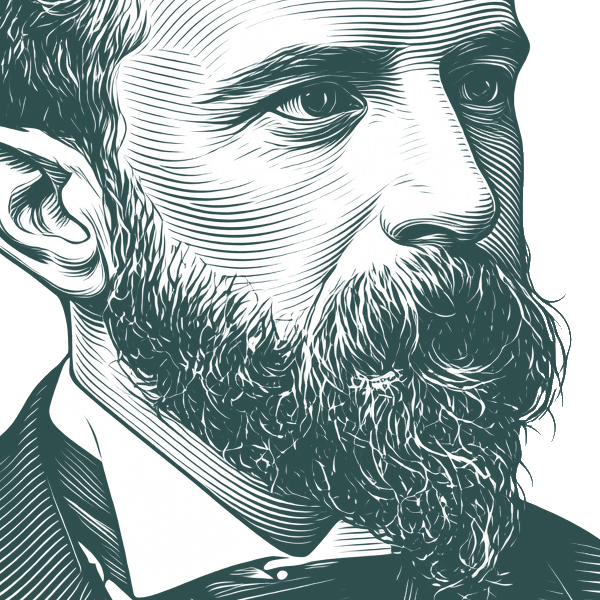
"Adams's diplomatic victory was Napoleonic in its magnitude and completeness, Even Caulaincourt, whom he overthrew, good-naturedly congratulated him … - Henry Adams
"Adams's diplomatic victory was Napoleonic in its magnitude and completeness, Even Caulaincourt, whom he overthrew, good-naturedly congratulated him after he had succeeded,against Caulaincourt"s utmost efforts,in saving all American ships."It seems you are great favorites here;you have found powerful protection,"said the defeated ambassador.The American minister felt but one drawback, he could not wholly believe that his victory was sure.Anxious by temperament,with little confidence in his own good fortune,fighting his battles with energy,but rather with that of despair than hope,the younger Adams never allowed himself to enjoy the full relish of a triumph before it staled, while he never failed to taste with the fullest flavor,as though it were a precious wine,every drop in the bitter cup of his defeats. In this, the most brilliant success of his diplomatic career, he could not be blamed for doubting whether such fortune could last. That the czar of Russia should persist in braving almost sure destruction in order to defend American rights which America herself proclaimed to be unassailed, passed the bounds of fiction.
Henry Brooks Adams (16 February 1838 – 27 March 1918) was a U.S. historian, journalist, novelist and educator. He was the great-grandson of John Adams, grandson of John Quincy Adams and son of Charles Francis Adams, Sr.
Biography information from
Wikiquote·
Portrait adapted from
Wikimedia Commons, William Notman (Public domain / CC0)
Any schoolboy could see that man as a force must be measured by motion, from a fixed point. Psychology helped here by suggesting a unit — the point of history when man held the highest idea of himself as a unit in a unified universe. Eight or ten years of study had led Adams to think he might use the century 1150-1250, expressed in Amiens Cathedral and the Works of Thomas Aquinas, as the unit from which he might measure motion down to his own time, without assuming anything as true or untrue, except relation. The movement might be studied at once in philosophy and mechanics. Setting himself to the task, he began a volume which he mentally knew as "Mont-Saint-Michel and Chartres: a Study of Thirteenth-Century Unity." From that point he proposed to fix a position for himself, which he could label: "The Education of Henry Adams: a Study of Twentieth-Century Multiplicity." With the help of these two points of relation, he hoped to project his lines forward and backward indefinitely, subject to correction from any one who should know better. Thereupon, he sailed for home.
No one has ventured to explain why the Virgin wielded exclusive power over poor and rich, sinners and saints alike. Why were all the Protestant churches cold failures without her help? Why could not the Holy Ghost,— the spirit of Love and Grace,— equally answer their prayers? Why was the Son powerless? Why was Chartres Cathedral — like Lourdes today — the expression of what is in substance a separate religion? Why did the gentle and gracious Virgin Mother so exasperate the Pilgrim Father? Why was the Woman struck out of the Church and ignored in the State? These questions are not antiquarian or trifling in historical value; they tug at the very heart-strings of all that makes whatever order is in the cosmos. If a Unity exists, in which and towards which all energies centre, it must explain and include Duality, Diversity, Infinity,— Sex!
He never labored so hard to learn a language as he did to hold his tongue, and it affected him for life. The habit of reticence — of talking without meaning — is never effaced.