He was the best kind of ordinary man, and when I say that he was an ordinary man, I mean that as high praise, not deprecation. That’s the highest pra… - Harry S. Truman
""
He was the best kind of ordinary man, and when I say that he was an ordinary man, I mean that as high praise, not deprecation. That’s the highest praise you can give a man, that he’s one of the people and becomes distinguished in the service that he gives other people. I don’t know of any higher compliment you can pay a man than that. He was one of the people, and he wanted to stay that way. And he was that way until the day he died. One of the reasons he was assassinated was because he didn’t feel important enough to have the proper guards around him at the Ford’s Theater.
English
Collect this quote
About
Harry S. Truman
Harry S. Truman (May 8, 1884 – December 26, 1972) was the 33rd president of the United States (1945–53), an American politician of the Democratic Party. He served as a United States senator from Missouri (1935–45) and briefly as vice president (1945) before he succeeded to the presidency on April 12, 1945 upon the death of Franklin D. Roosevelt. He was president during the final months of World War II, making the decision to drop the atomic bomb on Hiroshima and Nagasaki. Truman was elected in his own right in 1948. He presided over an uncertain domestic scene as America sought its path after the war, and tensions with the Soviet Union increased, marking the start of the Cold War.
Biography information from
Wikiquote·
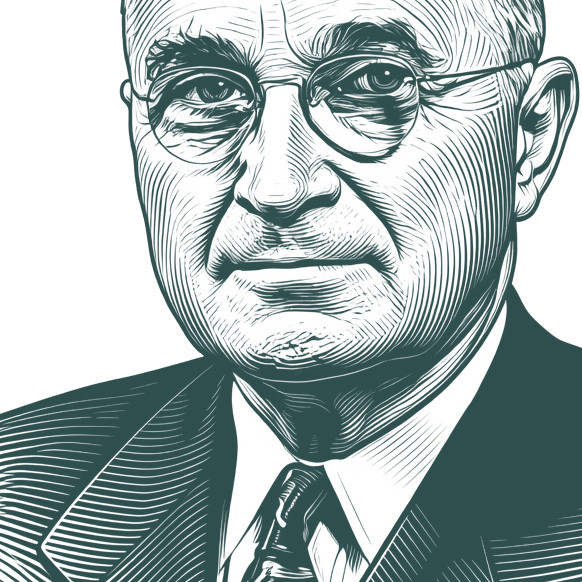
Portrait adapted from
Wikimedia Commons, National Archives and Records Administration. Office of Presidential Libraries. Harry S. Truman Library. (Public domain / CC0)
Also Known As
Alternative Names:
Harry Truman
•
Truman
•
President Truman
•
H. S. Truman
•
H. Truman
•
Harry S Truman
Portrait from Wikimedia Commons. Credit: National Archives and Records Administration. Office of Presidential Libraries. Harry S. Truman Library.. Used under Public domain / CC0. Processed and styled by Quotewise.
PREMIUM FEATURE
Advanced Search Filters
Filter search results by source, date, and more with our premium search tools.
In this shrinking world, it is futile to seek safety behind geographical barriers. Real security will be found only in law and in justice. Here in America, we have labored long and hard to achieve a social order worthy of our great heritage. In our time, tremendous progress has been made toward a really democratic way of life. Let me assure the forward-looking people of America that there will be no relaxation in our efforts to improve the lot of the common people.
Socialism is the epithet they have hurled at every advance the people have made.
PREMIUM FEATURE
Advanced Search Filters
Filter search results by source, date, and more with our premium search tools.