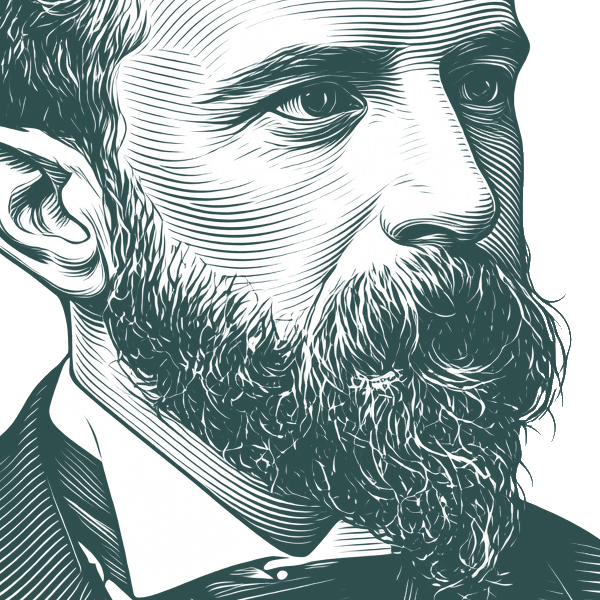
Henry Brooks Adams (16 February 1838 – 27 March 1918) was a U.S. historian, journalist, novelist and educator. He was the great-grandson of John Adams, grandson of John Quincy Adams and son of Charles Francis Adams, Sr.
Biography information from
Wikiquote·
Portrait adapted from
Wikimedia Commons, William Notman (Public domain / CC0)
Boys never see a conclusion; only on the edge of the grave can man conclude anything; but the first impulse given to the boy is apt to lead or drive him for the rest of his life into conclusion after conclusion that he never dreamed of reaching.
Abélard would find most of his old problems sensitive to his touch today. Time has settled few or none of the essential points of dispute. Science hesitates, more visibly than the Church ever did, to decide once for all whether Unity or Diversity is ultimate law; whether order or chaos is the governing rule of the Universe, if Universe there is; whether anything except phenomena exists. Even in matters more vital to society, one dares not speak too loud. Why, and for what, and to whom, is man a responsible agent? Every jury and judge, every lawyer and doctor, every legislator and clergyman has his own views, and the law constantly varies. Every nation may have a different system. One court may hang, and another may acquit for the same crime, on the same day; and Science only repeats what the Church said to Abélard, that where we know so little, we had better hold our tongues.
Try QuoteGPT
Chat naturally about what you need. Each answer links back to real quotes with citations.
Like so many other great observers, Langley was not a mathematician, and like most physicists, he believed in physics. Rigidly denying himself the amusement of philosophy, which consists chiefly in suggesting unintelligible answers to insoluble problems, he still knew the problems, and liked to wander past them in a courteous temper, even bowing to them distantly as though recognising their existence though doubting their respectability.