If these principles are sound, two conclusions follow. The individual and the local, state, and national political units ought to be permitted to ass… - Calvin Coolidge
""
If these principles are sound, two conclusions follow. The individual and the local, state, and national political units ought to be permitted to assume their own responsibilities. Any other course in the end will be subversive both of character and liberty. But it is equally clear that they in their turn must meet their obligations. If there is to be a continuation of individual and local self-government and of State sovereignty, the individual and locality must govern themselves and the State must assert its sovereignty. Otherwise these rights and privileges will be confiscated under the all-compelling pressure of public necessity for a better maintenance of order and morality. The whole world has reached a stage in which, if we do not set ourselves right, we may be perfectly sure that an authority will be asserted by others for the purpose of setting us right.
English
Collect this quote
About
Calvin Coolidge
John Calvin Coolidge Jr. (4 July 1872 – 5 January 1933) was the 30th president of the United States (1923–29). A Republican lawyer from Vermont, Coolidge worked his way up the ladder of Massachusetts state politics, eventually becoming governor of that state. His response to the Boston Police Strike of 1919 thrust him into the national spotlight and gave him a reputation as a man of decisive action. Soon after, he was elected as the 29th vice president in 1920 and succeeded to the presidency upon the sudden death of Warren G. Harding in 1923. Elected in his own right in 1924, he gained a reputation as a small-government conservative.
Biography information from
Wikiquote·
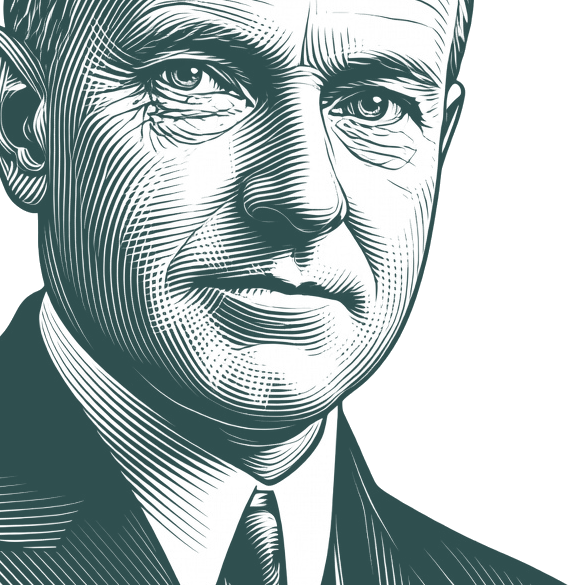
Portrait adapted from
Wikimedia Commons, Harris & Ewing (Public domain / CC0)
Also Known As
Birth Name:
John Calvin
Alternative Names:
John Calvin Coolidge Jr.
•
John Calvin Coolidge
•
President Coolidge
•
J. C. Coolidge
•
C. Coolidge
•
Silent Cal
•
Silent Cal Coolidge
We must not, in times of peace, permit ourselves to lose any part from this structure of patriotic unity. I make no plea for leniency toward those who are criminal or vicious, are open enemies of society and are not prepared to accept the true standards of our citizenship. By tolerance I do not mean indifference to evil. I mean respect for different kinds of good. Whether one traces his Americanisms back three centuries to the Mayflower, or three years to the steerage, is not half so important as whether his Americanism of today is real and genuine. No matter by what various crafts we came here, we are all now in the same boat. You men constituted the crew of our 'Ship of State' during her passage through the roughest waters. You made up the watch and held the danger posts when the storm was fiercest. You brought her safely and triumphantly into port. Out of that experience you have learned the lessons of discipline, tolerance, respect for authority, and regard for the basic manhood of your neighbor. You bore aloft a standard of patriotic conduct and civic integrity, to which all could repair. Such a standard, with a like common appeal, must be upheld just as firmly and unitedly now in time of peace. Among citizens honestly devoted to the maintenance of that standard, there need be small concern about differences of individual opinion in other regards. Granting first the essentials of loyalty to our country and to our fundamental institutions, we may not only overlook, but we may encourage differences of opinion as to other things. For differences of this kind will certainly be elements of strength rather than of weakness. They will give variety to our tastes and interests. They will broaden our vision, strengthen our understanding, encourage the true humanities, and enrich our whole mode and conception of life. I recognize the full and complete necessity of 100 per cent Americanism, but 100 per cent Americanism may be made up of many various elements.
It is my belief that action under this section should be suspended until the Congress can reconsider the entire question in the light of the experience that has been developed since its enactment.
Works in ChatGPT, Claude, or Any AI
Add semantic quote search to your AI assistant via MCP. One command setup.