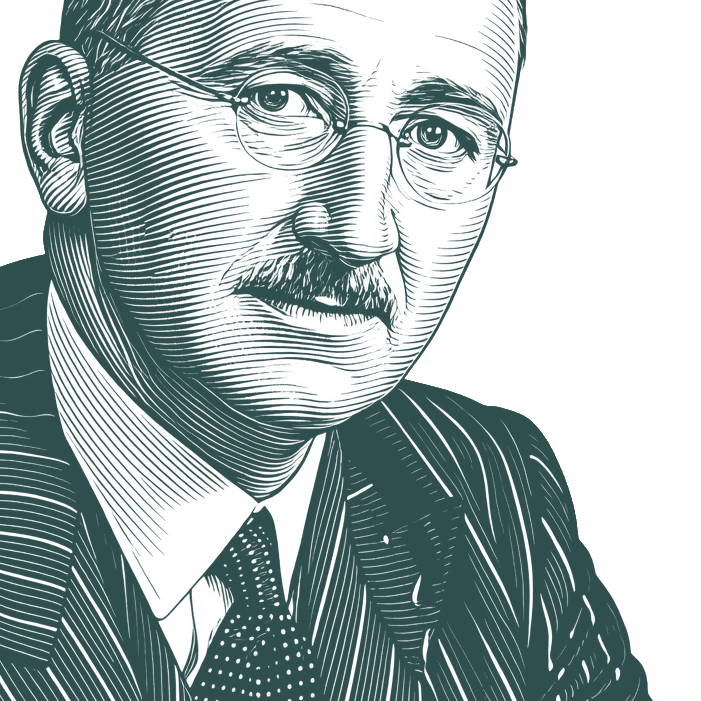
When I look at the world, I sometimes feel that here in Germany one may still be in some sort of lifeboat that can hope to keep afloat when the rest … - Friedrich Hayek
""
When I look at the world, I sometimes feel that here in Germany one may still be in some sort of lifeboat that can hope to keep afloat when the rest of the world goes bust. German and Switzerland and perhaps Austria and Belgium have the few relatively stable currencies in the world.
Friedrich August von Hayek CH (8 May 1899 – 23 March 1992) was an Austrian, later British, economist and philosopher best known for his defense of classical liberalism. In 1974, Hayek shared the (with Gunnar Myrdal) for his "pioneering work in the theory of money and economic fluctuations and … penetrating analysis of the interdependence of economic, social and institutional phenomena". (Nobel Memorial Prize, 1974)
Portrait adapted from
Wikimedia Commons, The original uploader was DickClarkMises at English Wikipedia. (CC BY-SA)
Also Known As
Native Name:
Friedrich August von Hayek
Alternative Names:
Friedrich von Hayek
•
Friedrich A. von Hayek
•
Friedrich A. Von Hayek
•
F. A. von Hayek
•
Friedrich August Von Hayek
•
Hayek
•
F. A. Hayek
Portrait from Wikimedia Commons. Credit: The original uploader was DickClarkMises at English Wikipedia.. Used under CC BY-SA. Processed and styled by Quotewise.
Works in ChatGPT, Claude, or Any AI
Add semantic quote search to your AI assistant via MCP. One command setup.
I don’t have many strong dislikes. I admit that as a teacher—I have no racial prejudices in general—but there were certain types, and conspicuous among them the Near Eastern populations, which I still dislike because they are fundamentally dishonest. And I must say dishonesty is a thing I intensely dislike. It was a type which, in my childhood in Austria, was described as Levantine, typical of the people of the eastern Mediterranean. But I encountered it later, and I have a profound dislike for the typical Indian students at the London School of Economics, which I admit are all one type—Bengali moneylender sons. They are to me a detestable type, I admit, but not with any racial feeling. I have found a little of the same amongst the Egyptians —basically a lack of honesty in them. If I advise speaking about honesty, I think honesty is really the best expression of what I call the morals of a civilized society. Primitive man lacks a conception of honesty.
[Apartheid law in South Africa] appears to be a clear and even extreme instance of that discrimination between different individuals which seems to me to be incompatible with the reign of liberty. The essence of what I said [in The Constitution of Liberty] was really the fact that the laws under which government can use coercion are equal for all responsible adult members of that society. Any kind of discrimination — be it on grounds of religion, political opinion, race, or whatever it is — seems to be incompatible with the idea of freedom under the law. Experience has shown that separate never is equal and cannot be equal.
Our whole modern society, based on a far-ranging division of labour, is, however, essentially dependent on two factors that conflict with our natural instincts. The first is the assumption, implicit but not understood, that we can do more good to unknown people if we follow the impersonal signals of the market, which enable us to serve the needs of people whom we do not know and to make use of opportunities and facilities with which we have no direct acquaintance. The second is that for this purpose we can follow our own individual aims with freely chosen associates and are not bound to serve the concrete ends of the group into which we were born.