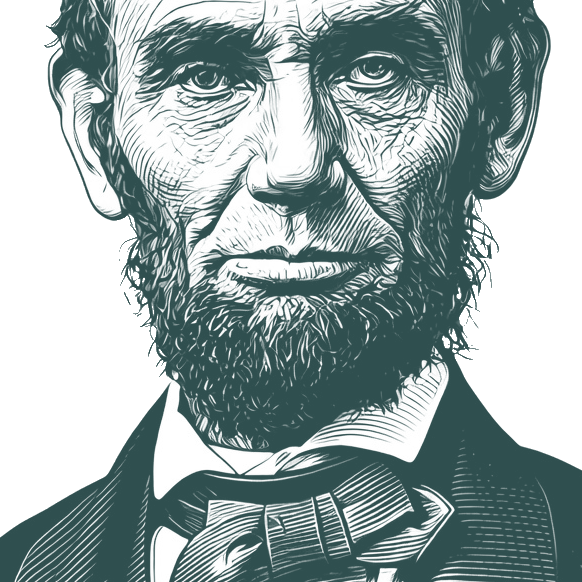
Human nature will not change. In any future great national trial, compared with the men of this, we shall have as weak and as strong, as silly and as… - Abraham Lincoln
""
Human nature will not change. In any future great national trial, compared with the men of this, we shall have as weak and as strong, as silly and as wise, as bad and as good. Let us therefore study the incidents of this, as philosophy to learn wisdom from.
English
Collect this quote
About
Abraham Lincoln
Abraham Lincoln (12 February 1809 – 15 April 1865) was the 16th president of the United States, serving from March 1861 until his assassination in April 1865. Initially entering politics as a Whig, he became a member of the US congress from Illinois, and later the first Republican president, leading Union forces throughout the moral, constitutional, political and military crises of the American Civil War, during which he abolished slavery and strengthened the U.S. government.
Biography information from
Wikiquote·
Portrait adapted from
Wikimedia Commons, Alexander Gardner (Public domain / CC0)
Also Known As
Alternative Names:
Honest Abe
•
President Lincoln
•
Abe Lincoln
•
Uncle Abe
•
A. Lincoln
•
Lincoln
When I so pressingly urge a strict observance of all the laws, let me not be understood as saying there are no bad laws, or that grievances may not arise for the redress of which no legal provisions have been made. I mean to say no such thing. But I do mean to say that although bad laws, if they exist, should be repealed as soon as possible, still, while they continue in force, for the sake of example they should be religiously observed. So also in unprovided cases. If such arise, let proper legal provisions be made for them with the least possible delay, but till then let them, if not too intolerable, be borne with.
There are those who are dissatisfied with me. To such I would say: You desire peace; and you blame me that we do not have it. But how can we attain it? There are but three conceivable ways. First, to suppress the rebellion by force of arms. This, I am trying to do. Are you for it? If you are, so far we are agreed. If you are not for it, a second way is, to give up the Union. I am against this. Are you for it? If you are, you should say so plainly. If you are not for force, nor yet for dissolution, there only remains some imaginable compromise. I do not believe any compromise, embracing the maintenance of the Union, is now possible. All I learn, leads to a directly opposite belief. The strength of the rebellion, is its military — its army. That army dominates all the country, and all the people, within its range. Any offer of terms made by any man or men within that range, in opposition to that army, is simply nothing for the present; because such man or men, have no power whatever to enforce their side of a compromise, if one were made with them.
Allow the President to invade a neighboring nation, whenever he shall deem it necessary to repel an invasion, and you allow him to do so, whenever he may choose to say he deems it necessary for such purpose, and you allow him to make war at pleasure. Study to see if you can fix any limit to his power in this respect, after having given him so much as you propose. If, to-day, he should choose to say he thinks it necessary to invade Canada, to prevent the British from invading us, how could you stop him? You may say to him, "I see no probability of the British invading us" but he will say to you, "Be silent; I see it, if you don't." The provision of the Constitution giving the war making power to Congress was dictated, as I understand it, by the following reasons. Kings had always been involving and impoverishing their people in wars, pretending generally, if not always, that the good of the people was the object. This, our Convention understood to be the most oppressive of all Kingly oppressions; and they resolved to so frame the Constitution that no one man should hold the power of bringing this oppression upon us. But your view destroys the whole matter, and places our President where kings have always stood.