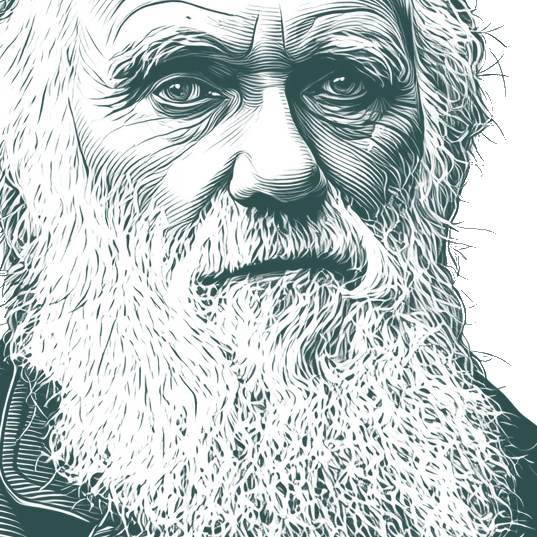
After a time the minute colourless particles which are imbedded in the flowing protoplasm are drawn towards and unite with the aggregated masses; so … - Charles Darwin
""
After a time the minute colourless particles which are imbedded in the flowing protoplasm are drawn towards and unite with the aggregated masses; so that the protoplasm on the walls being now rendered quite transparent is no longer visible, though some is still present, and still flows, as may be inferred from the occasional transport of particles in the cell-sap.
English
Collect this quote
About
Charles Darwin
Charles Robert Darwin (12 February 1809 – 19 April 1882) was an English naturalist, geologist and biologist, best known for his contributions to the science of evolution. He proposed that evolution could be explained in part through natural and sexual selection. Prompted by awareness that Alfred Russel Wallace was developing similar theories he published his own sooner than he had originally intended. This theory is now an integral component of biological science.
Biography information from
Wikiquote·
Portrait adapted from
Wikimedia Commons, Herbert Rose Barraud (Public domain / CC0)
Also Known As
Birth Name:
Charles Robert Darwin
Alternative Names:
Charles R. Darwin
•
C. R. Darwin
•
Darwin
•
C.R. Darwin
•
CR Darwin
These [calciferous] glands (see Fig. 1), judging from their size and from their rich supply of blood-vessels, must be of much importance to the animal. But almost as many theories have been advanced on their use as there have been observers.
Believing as I do that man in the distant future will be a far more perfect creature than he now is, it is an intolerable thought that he and all other sentient beings are doomed to complete annihilation after such long-continued slow progress. To those who fully admit the immortality of the human soul, the destruction of our world will not appear so dreadful.
Enhance Your Quote Experience
Enjoy ad-free browsing, unlimited collections, and advanced search features with Premium.
But just in proportion as this process of extermination has acted on an enormous scale, so must the number of intermediate varieties, which have formerly existed on the earth, be truly enormous. Why then is not every geological formation and every stratum full of such intermediate links? Geology assuredly does not reveal any such finely graduated organic chain; and this, perhaps, is the most obvious and gravest objection which can be urged against my theory. The explanation lies, as I believe, in the extreme imperfection of the geological record.