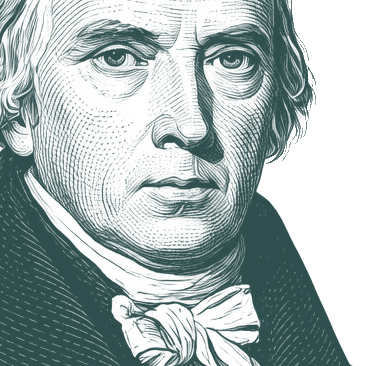
It is *essential* to such a government, that it be derived from the great body of the society, not from an inconsiderable proportion, or a favored cl… - James Madison
""
It is *essential* to such a government, that it be derived from the great body of the society, not from an inconsiderable proportion, or a favored class of it; otherwise a handful of tyrannical nobles, exercising their oppressions by a delegation of their powers, might aspire to the rank of republicans, and claim for their government the honorable title of republic.
English
Collect this quote
About
James Madison
James Madison Jr. (16 March 1751 – 28 June 1836) was an American statesman, diplomat, and Founding Father who served as the fourth president of the United States from 1809 to 1817. Madison was popularly acclaimed the "Father of the Constitution" for his pivotal role in drafting and promoting the Constitution of the United States and the Bill of Rights.
Biography information from
Wikiquote·
Portrait adapted from
Wikimedia Commons, John Vanderlyn (Public domain / CC0)
Also Known As
Birth Name:
James Madison, Jr.
Alternative Names:
James Madison Jr.
•
President Madison
•
President James Madison
Mr. MASON. Some mode of displacing an unfit magistrate is rendered indispensable by the fallibility of those who choose, as well as by the corruptibility of the man chosen. He opposed decidedly the making the Executive the mere creature of the Legislature as a violation of the fundamental principle of good Government. Mr. MADISON & Mr. WILSON observed that it would leave an equality of agency in the small with the great States; that it would enable a minority of the people to prevent ye. removal of an officer who had rendered himself justly criminal in the eyes of a majority; that it would open a door for intrigues agst. him in States where his administration tho' just might be unpopular, and might tempt him to pay court to particular States whose leading partizans he might fear, or wish to engage as his partizans. They both thought it bad policy to introduce such a mixture of the State authorities, where their agency could be otherwise supplied. Mr. DICKENSON considered the business as so important that no man ought to be silent or reserved. He went into a discourse of some length, the sum of which was, that the Legislative, Executive, & Judiciary departments ought to be made as independent. as possible; but that such an Executive as some seemed to have in contemplation was not consistent with a republic: that a firm Executive could only exist in a limited monarchy.
Man who preys both on the vegetable and animal species, is himself a prey to neither. He too possesses the reproductive principle far beyond the degree requisite for the bare continuance of his species. What becomes of the surplus of human life to which this principle is competent? It is either, 1st. destroyed by infanticide, as among the Chinese and Lacedemonians; or 2d. it is stifled or starved, as among other nations whose population is commensurate to its food; or 3d. it is consumed by wars and endemic diseases; or 4th. it overflows, by emigration, to places where a surplus of food is attainable.
Try QuoteGPT
Chat naturally about what you need. Each answer links back to real quotes with citations.
The man who is possessed of wealth, who lolls on his sofa, or rolls in his carriage, cannot judge of the wants or feelings of the day laborer. The government we mean to erect is intended to last for ages. ... unless wisely provided against, what will become of your government? In England, at this day, if elections were open to all classes of people, the property of the landed proprietors would be insecure. An agrarian law would soon take place. If these observations be just, our government ought to secure the permanent interests of the country against innovation. Landholders ought to have a share in the government, to support these invaluable interests, and to balance and check the other. They ought to be so constituted as to protect the minority of the opulent against the majority. The senate, therefore, ought to be this body; and to answer these purposes...