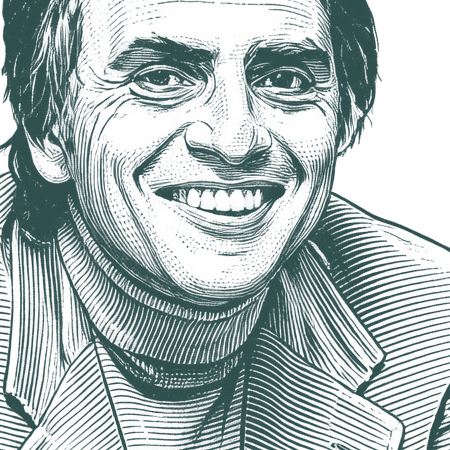
Voltaire argued that if God did not exist Man would be obliged to invent him, and was reviled for the remark. - Carl Sagan
""
Voltaire argued that if God did not exist Man would be obliged to invent him, and was reviled for the remark.
English
Collect this quote
About
Carl Sagan
Carl Edward Sagan (9 November 1934 – 20 December 1996) was an American astronomer, planetary scientist, cosmologist, astrophysicist, astrobiologist, author, and science communicator. His best known scientific contribution is research on extraterrestrial life, including experimental demonstration of the production of amino acids from basic chemicals by radiation. Sagan assembled the first physical messages sent into space, the Pioneer plaque and the Voyager Golden Record, universal messages that could potentially be understood by any extraterrestrial intelligence that might find them. Sagan argued the hypothesis, accepted since, that the high surface temperatures of Venus can be attributed to, and calculated using, the greenhouse effect. He testified to the US Congress in 1985 that the greenhouse effect will change the earth's climate system.
Biography information from
Wikiquote·
Portrait adapted from
Wikimedia Commons, NASA/JPL (Public domain / CC0)
Also Known As
Native Name:
Carl Edward Sagan
Alternative Names:
Sagan
•
Carl E. Sagan
•
Carl E Sagan
•
C. E. Sagan
•
C.E. Sagan
•
C E Sagan
•
C. Sagan
•
C Sagan
•
Sagan C
•
Sagan C.
•
Sagan C. E.
•
Sagan CE
what’s the difference between an invisible, incorporeal, floating dragon who spits heatless fire and no dragon at all?
When all is said and done, the invention of writing must be reckoned not only as a brilliant innovation but as a surpassing good for humanity. And assuming that we survive long enough to use their inventions wisely, I believe the same will be said of the modern Thoths and Prometheuses who are today devising computers and programs at the edge of machine intelligence.
Limited Time Offer
Premium members can get their quote collection automatically imported into their Quotewise collections.
As in all such technological nightmares, the principal task is to foresee what is possible; to educate use and misuse; and to prevent its organizational, bureaucratic and governmental abuse.