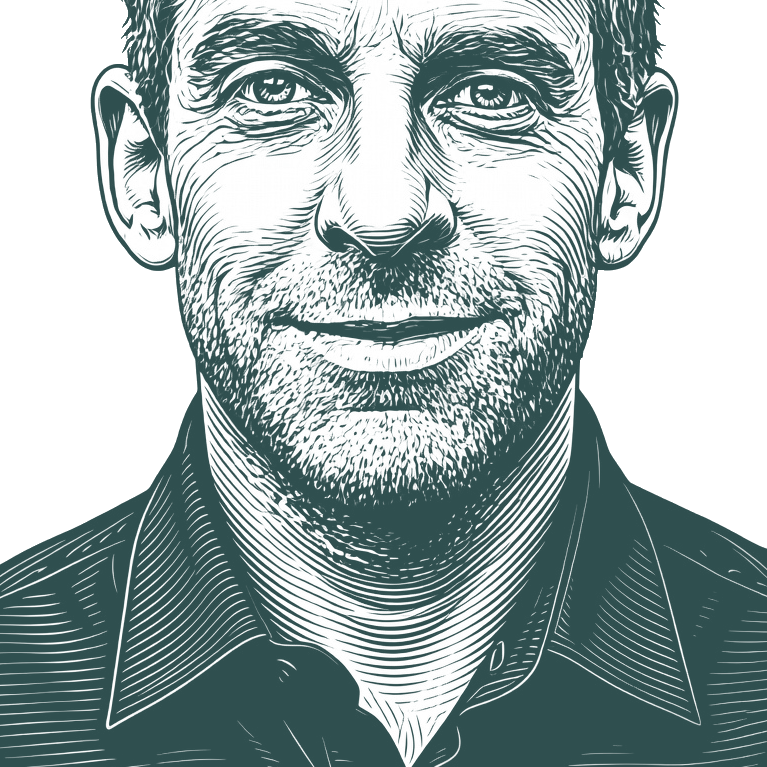
Could there be any doubt that the Jews would seek to harm the Son of God again, knowing that his body was now readily accessible in the form of defen… - Sam Harris
""
Could there be any doubt that the Jews would seek to harm the Son of God again, knowing that his body was now readily accessible in the form of defenseless crackers?
Samuel Benjamin Harris (born April 9, 1967) is an American author, philosopher, public intellectual, and neuroscientist, as well as the co-founder and CEO of Project Reason. He is the author of The End of Faith (2004), which won the PEN/Martha Albrand Award for First Nonfiction in 2005 and appeared on The New York Times best seller list for 33 weeks, Letter to a Christian Nation (2006), The Moral Landscape (2010), Lying (2011), Free Will (2012), and most recently Waking Up: A Guide to Spirituality Without Religion (2014).
Biography information from
Wikiquote·
Portrait adapted from
Wikimedia Commons, Cmichel67 (Christopher Michel) (CC BY-SA)
One need only read the Koran to know, with something approaching mathematical certainty, that all truly devout Muslims will be “convinced of the superiority of their culture, and obsessed with the inferiority of their power,
The self that does not survive scrutiny is the subject of experience in each present moment — the feeling of being a thinker of thoughts inside one’s head, the sense of being an owner or inhabitant of a physical body, which this false self seems to appropriate as a kind of vehicle. Even if you don’t believe such a homunculus exists — perhaps because you believe, on the basis of science, that you are identical to your body and brain rather than a ghostly resident therein — you almost certainly feel like an internal self in almost every waking moment. And yet, however one looks for it, this self is nowhere to be found. It cannot be seen amid the particulars of experience, and it cannot be seen when experience itself is viewed as a totality. However, its absence can be found — and when it is, the feeling of being a self disappears.
Faith drives a wedge between ethics and suffering. Where certain actions cause no suffering at all, religious dogmatists still maintain that they are evil and worth of punishment (sodomy, marijuana use, homosexuality, the killing of blastocysts, etc). And yet, where suffering and death are found in abundance their causes are often deemed to be good (withholding funds for family planning in the third world, prosecuting nonviolent drug offenders, preventing stem cell research, etc). This inversion of priorities not only victimizes innocent people and squanders scarce resources; it completely falsifies our ethics. It is time we found a more reasonable approach to answering questions of right and wrong.