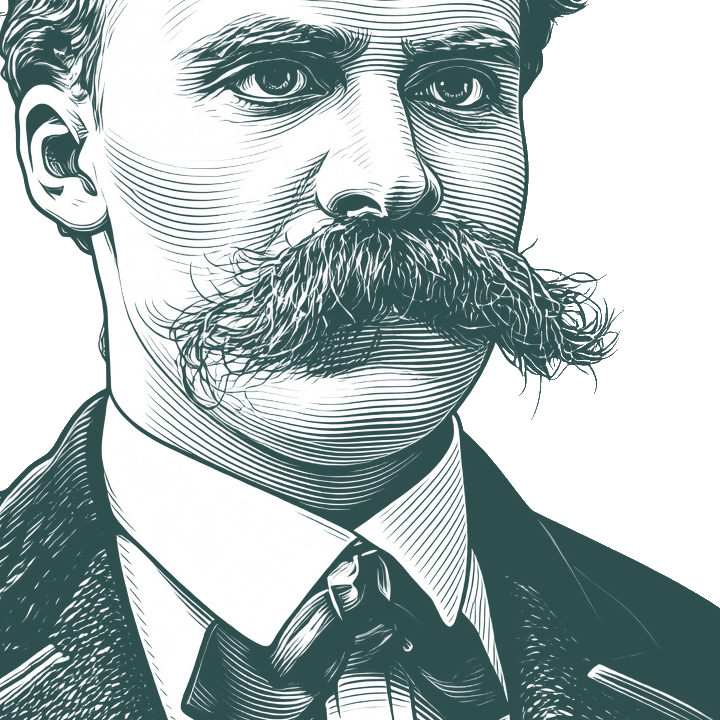
"Suppose a human being has thus put his ear, as it were, to the heart chamber of the world will and felt the roaring desire for existence pouring fro… - Friedrich Nietzsche
"Suppose a human being has thus put his ear, as it were, to the heart chamber of the world will and felt the roaring desire for existence pouring from there into all the veins of the world, as a thundering current or as the gentlest brook, dissolving into a mist — how could he fail to break suddenly? How could he endure to perceive the echo of innumerable shouts of pleasure and woe in the "wide space of the world night," enclosed in the wretched glass capsule of the human individual, without inexorably fleeing toward his primordial home, as he hears this shepherd's dance of metaphysics? But if such a work could nevertheless be perceived as a whole, without denial of individual existence; if such a creation could be created without smashing its creator — whence do we take the solution of such a contradiction?"
English
Collect this quote
About
Friedrich Nietzsche
Friedrich Wilhelm Nietzsche (15 October 1844 – 25 August 1900) was a German philosopher, cultural critic, composer, poet, writer, and philologist whose work has exerted a profound influence on modern intellectual history. His critiques of contemporary culture, religion, and philosophy centered on a basic question regarding the foundation of values and morality.
Biography information from
Wikiquote·
Portrait adapted from
Wikimedia Commons, Friedrich Hermann Hartmann (Public domain / CC0)
Also Known As
Alternative Names:
Friedrich Wilhelm Nietzsche
•
Nietzsche
You run ahead? Are you doing it as a shepherd? Or as an exception? A third case would be as a fugitive. First question of conscience.
Are you genuine? Or merely an actor? A representative? Or that which is represented? In the end, perhaps you are merely a copy of an actor. Second question of conscience.
Are you one who looks on? Or one who lends a hand? Or one who looks away and walks off? Third question of conscience.
Do you want to walk along? Or walk ahead? Or walk by yourself? One must know what one wants and that one wants. Fourth question of conscience.
Energy wasted on negative ends.
PREMIUM FEATURE
Advanced Search Filters
Filter search results by source, date, and more with our premium search tools.
The various languages placed side by side show that with words it is never a question of truth, never a question of adequate expression; otherwise, there would not be so many languages. The "thing in itself" (which is precisely what the pure truth, apart from any of its consequences, would be) is likewise something quite incomprehensible to the creator of language and something not in the least worth striving for. This creator only designates the relations of things to men, and for expressing these relations he lays hold of the boldest metaphors.' To begin with, a nerve stimulus is transferred into an image: first metaphor. The image, in turn, is imitated in a sound: second metaphor. And each time there is a complete overleaping of one sphere, right into the middle of an entirely new and different one.