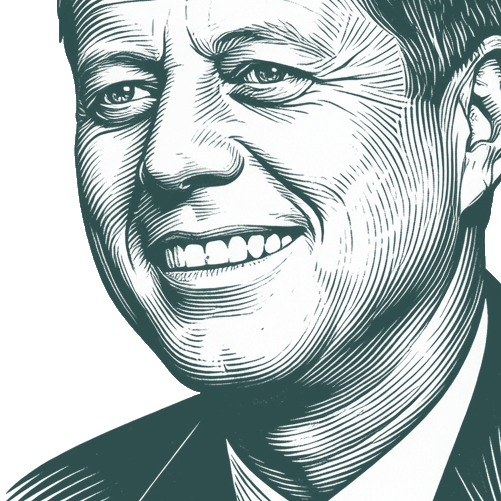
This is also our great opportunity in 1961. If we grasp it, then subversion to prevent its success is exposed as an unjustifiable attempt to keep the… - John F. Kennedy
""
This is also our great opportunity in 1961. If we grasp it, then subversion to prevent its success is exposed as an unjustifiable attempt to keep these nations from either being free or equal. But if we do not pursue it, and if they do not pursue it, the bankruptcy of unstable governments, one by one, and of unfilled hopes will surely lead to a series of totalitarian receiverships.
John Fitzgerald Kennedy (29 May 1917 – 22 November 1963), often referred to by his initials JFK and Jack, was the 35th president of the United States (1961–1963), a United States senator from Massachusetts (1953–1960), and a United States representative (1947–1953). Kennedy served at the height of the Cold War, and the majority of his work as president concerned relations with the Soviet Union and Cuba. He is the older brother of Robert F. Kennedy and Ted Kennedy, and the first husband of Jacqueline Kennedy Onassis. He was shot in the presence of his wife in Dallas on November 22, 1963.
Portrait adapted from
Wikimedia Commons, Cecil W. Stoughton (Public domain / CC0)
Also Known As
Birth Name:
John Fitzgerald Kennedy
Also Known As:Jack
Alternative Names:
Kennedy
•
Jack Kennedy
•
President Kennedy
•
J. F. Kennedy
•
JFK
•
John Kennedy
•
John Fitzgerald "Jack" Kennedy
•
JF Kennedy
•
John F Kennedy
This is a great country and requires a good deal of all of us, so I can imagine nothing more important than for all of you to continue to work in public affairs and be interested in them, not only to bring up a family, but also give part of your time to your community, your state, and your country.
There's an old saying that victory has a hundred fathers and defeat is an orphan.... I'm the responsible officer of the Government.
PREMIUM FEATURE
Advanced Search Filters
Filter search results by source, date, and more with our premium search tools.
I look forward to a great future for America, a future in which our country will match its military strength with our moral restraint, its wealth with our wisdom, its power with our purpose. I look forward to an America which will not be afraid of grace and beauty, which will protect the beauty of our natural environment, which will preserve the great old American houses and squares and parks of our national past, and which will build handsome and balanced cities for our future.