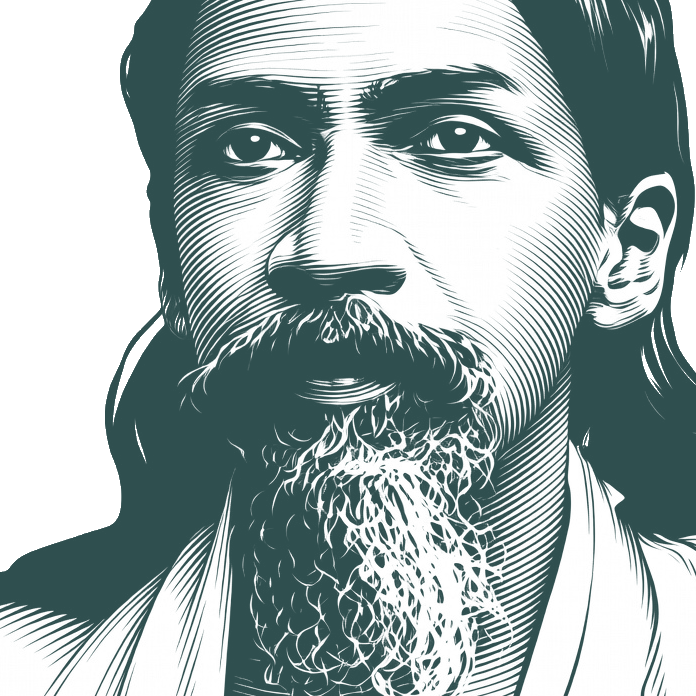
When I was mounting upon ever higher crests of His joy, I asked myself whether there was no limit to the increase of bliss and almost I grew afraid o… - Aurobindo Ghosh
""
When I was mounting upon ever higher crests of His joy, I asked myself whether there was no limit to the increase of bliss and almost I grew afraid of God's embraces.
Sri Aurobindo [born Aravinda Akroyd Ghose] (15 August 1872 – 5 December 1950) was an Indian nationalist, scholar, poet, mystic, philosopher, yogi and guru, who developed concepts of human progress and spiritual evolution. With the help of his spiritual collaborator, Mirra Alfassa, he founded the Sri Aurobindo Ashram.
Biography information from
Wikiquote·
Portrait adapted from
Wikimedia Commons, Rudolf 1922 (Public domain / CC0)
Also Known As
Native Name:
অরবিন্দ ঘোষ
Alternative Names:
Sri Aurobindo Ghose
•
Sri Orobindo
•
Orobindo Ghosh
•
Shri Aurobindo
•
Aurobindo Ghose
•
Sri Aurobindo
•
Aurobindo
•
Aravinda Ackroyd Ghose
•
A.A.Ghosh
•
A.G.
•
Maharshi Aravind Babu
India can best develop herself and serve humanity by being herself and following the law of her own nature. This does not mean, as some narrowly and blindly suppose, the rejection of everything new that comes to us in the stream of Time or happens to have been first developed or powerfully expressed by the West. Such an attitude would be intellectually absurd, physically impossible, and above all unspiritual; true spirituality rejects no new light, no added means or materials of our human self-development. It means simply to keep our centre, our essential way of being, our inborn nature and assimilate to it all we receive, and evolve out of it all we do and create.
We cannot afford to raise any institution to the rank of a fetish. To do so would be simply to become the slaves of our own machinery.
Go Premium
Support Quotewise while enjoying an ad-free experience and premium features.
Hinduism, which is the most skeptical and the most believing of all, the most skeptical because it has questioned and experimented the most, the most believing because it has the deepest experience and the most varied and positive spiritual knowledge, that wider Hinduism which is not a dogma or combination of dogmas but a law of life, which is not a social framework but the spirit of a past and [future]] social evolution, which rejects nothing but insists on testing and experiencing everything and when tested and experienced, turning in to the soul's uses, in this Hinduism, we find the basis of future world religion. This Sanatana Dharma has many scriptures: The Veda, the Vedanta, the Gita, the Upanishads, the Darshanas, the Puranas, the Tantras, nor could it reject the Bible or the Koran, but its real, the most authoritative scripture is in the heart in which the Eternal has his dwelling.