Mandela taught us the power of action, but he also taught us the power of ideas; the importance of reason and arguments; the need to study not only t… - Barack Obama
""
Mandela taught us the power of action, but he also taught us the power of ideas; the importance of reason and arguments; the need to study not only those who you agree with, but also those who you don’t agree with. He understood that ideas cannot be contained by prison walls, or extinguished by a sniper’s bullet. He turned his trial into an indictment of apartheid because of his eloquence and his passion, but also because of his training as an advocate. He used decades in prison to sharpen his arguments, but also to spread his thirst for knowledge to others in the movement. And he learned the language and the customs of his oppressor so that one day he might better convey to them how their own freedom depend upon his.
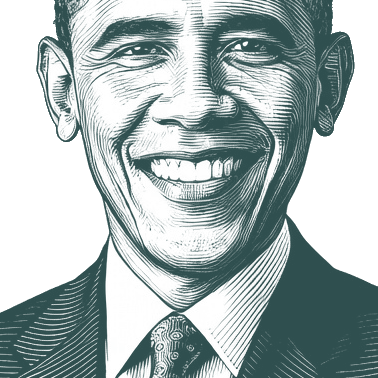
Barack Hussein Obama II (born August 4, 1961) is an American politician who served as the 44th president of the United States of America from 2009 to 2017. Born in Hawaii, the son of a Kenyan father and a mother from Kansas, he won the 2008 presidential election and was re-elected president in November 2012. A member of the U.S. Democratic Party, he was the first African American president. Before becoming president, he represented the 13th district for three terms in the Illinois Senate from 1997 to 2004 and served as United States senator from Illinois between January 4, 2005 and November 16, 2008. While president, he was the recipient of the 2009 Nobel Peace Prize.
Biography information from
Wikiquote·
Portrait adapted from
Wikimedia Commons, Official White House Photo by Pete Souza (Public domain / CC0)
Also Known As
Birth Name:
Barack Hussein Obama II
Also Known As:Barry
Alternative Names:
POTUS 44
•
Barack Hussein Obama
•
Barack H. Obama
•
Barack Hussein Obama, Jr.
•
Barack H Obama
•
Barak Obama
•
Barry Obama
•
Barack Obama II
If poverty is a disease that infects an entire community in the form of unemployment and violence, failing schools and broken homes, then we can't just treat those symptoms in isolation. We have to heal that entire community. And we have to focus on what actually works
In reaffirming the greatness of our nation, we understand that greatness is never a given. It must be earned. Our journey has never been one of short-cuts or settling for less. It has not been the path for the faint-hearted — for those who prefer leisure over work, or seek only the pleasures of riches and fame. Rather, it has been the risk-takers, the doers, the makers of things — some celebrated but more often men and women obscure in their labor, who have carried us up the long, rugged path towards prosperity and freedom. [...] Time and again these men and women struggled and sacrificed and worked till their hands were raw so that we might live a better life. They saw America as bigger than the sum of our individual ambitions; greater than all the differences of birth or wealth or faction.
PREMIUM FEATURE
Advanced Search Filters
Filter search results by source, date, and more with our premium search tools.
I was from everywhere and nowhere at once, a combination of ill-fitting parts, like a platypus or some imaginary beast, confined to a fragile habitat, unsure of where I belonged. And I sensed, without fully understanding why or how, that unless I could stitch my life together and situate myself along some firm axis, I might end up in some basic way living my life alone. I didn’t talk to anyone about this, certainly not my friends or family. I didn’t want to hurt their feelings or stand out more than I already did. But I did find refuge in books.