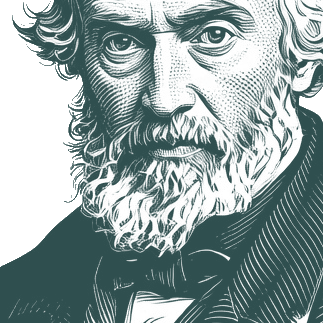
Thomas Carlyle (December 4 1795 – February 5 1881) was a Scottish essayist, historian and philosopher of great prominence during the Victorian era. His wife was Jane Welsh Carlyle.
Biography information from
Wikiquote·
Portrait adapted from
Wikimedia Commons, Sir John Everett Millais, 1st Bt (died 1896) (Public domain / CC0)
Portrait from Wikimedia Commons. Credit: Sir John Everett Millais, 1st Bt (died 1896). Used under Public domain / CC0. Processed and styled by Quotewise.
Enhance Your Quote Experience
Enjoy ad-free browsing, unlimited collections, and advanced search features with Premium.
It must have been in his teens, perhaps rather early, that he and his elder brother John, with William Bell (afterwards of Wylie Hill, and a noted drover) and his brother, all met in the kiln at Eelief to play cards. The corn was dried then at home. There was a fire, therefore, aud perhaps it was both heat and light. The boys had played, perhaps, often enough for trifling stakes, and always parted in good humor. One night they came to some disagreement. My father spoke out what was in him about the folly, the sinfulness, of quarreling over a perhaps sinful amusement. The earnest mind persuaded other minds. They threw the cards into the fire, and (I think the younger Bell told my brother James) no one of the four ever touched a card again through life. My father certainly never hinted at such a game since I knew him. I cannot remember that I, at that age, had any such force of belief. Which of us can?
It is now almost my sole rule of life to clear myself of cants and formulas, as of poisonous Nessus shirts.
Unlimited Quote Collections
Organize your favorite quotes without limits. Create themed collections for every occasion with Premium.
For what imaginable purpose was man made, if not to be "happy"? By victorious Analysis, and Progress of the Species, happiness enough now awaits him. Kings can become philosophers; or else philosophers Kings. Let but Society be once rightly constituted,—by victorious Analysis. The stomach that is empty shall be filled; the throat that is dry shall be wetted with wine. Labour itself shall be all one as rest; not grievous, but joyous Wheat-fields, one would think, cannot come to grow untilled; no man made clayey, or made weary thereby;—unless indeed machinery will do it? Gratuitous Tailors and Restaurateurs may start up, at fit intervals, one as yet sees not how. But if each will, according to rule of Benevolence, have a care for all, then surely—no one will be uncared for. Nay, who knows but by sufficiently victorious Analysis, "human life may be indefinitely lengthened," and men get rid of Death, as they have already done of the Devil? We shall then be happy in spite of Death and the Devil.