But the first ingredient, let me emphasize, is the cessation of work on missile sites on Cuba and measures to render such weapons inoperable, under e… - John F. Kennedy
""
But the first ingredient, let me emphasize, is the cessation of work on missile sites on Cuba and measures to render such weapons inoperable, under effective international guarantees. The continuations of this threat, or prolonging of this discussion concerning Cuba by linking these problems to the broader questions of European and world security, would surely lead to the peace of the world. For this reason I hope we can quickly agree along the lines outlined in this letter of October 26th.
English
Collect this quote
About
John F. Kennedy
John Fitzgerald Kennedy (29 May 1917 – 22 November 1963), often referred to by his initials JFK and Jack, was the 35th president of the United States (1961–1963), a United States senator from Massachusetts (1953–1960), and a United States representative (1947–1953). Kennedy served at the height of the Cold War, and the majority of his work as president concerned relations with the Soviet Union and Cuba. He is the older brother of Robert F. Kennedy and Ted Kennedy, and the first husband of Jacqueline Kennedy Onassis. He was shot in the presence of his wife in Dallas on November 22, 1963.
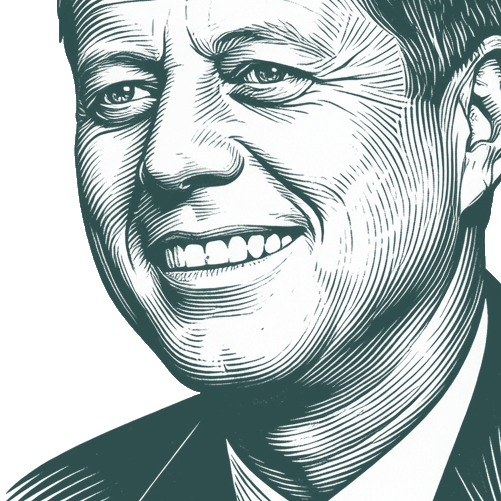
Portrait adapted from
Wikimedia Commons, Cecil W. Stoughton (Public domain / CC0)
Also Known As
Birth Name:
John Fitzgerald Kennedy
Also Known As:Jack
Alternative Names:
Kennedy
•
Jack Kennedy
•
President Kennedy
•
J. F. Kennedy
•
JFK
•
John Kennedy
•
John Fitzgerald "Jack" Kennedy
•
JF Kennedy
•
John F Kennedy
I look forward to an America which will reward achievement in the arts as we reward achievement in business or statecraft. I look forward to an America which will steadily raise the standards of artistic accomplishment and which will steadily enlarge cultural opportunities for all of our citizens. And I look forward to an America which commands respect throughout the world not only for its strength but for its civilization as well. And I look forward to a world which will be safe not only for democracy and diversity but also for personal distinction.
The great struggle in the world today is not one of popularity but one of power, and our power depends in considerable measure upon our ability to influence other nations, upon their willingness to associate themselves with our efforts, upon the strength of our stature and leadership. ... this deterioration in our prestige abroad threatens our bases, our alliances, our security and the peace itself and it is time we were respected once again throughout the would as the good neighbor.
This Administration has been looking hard at exactly what civil defense can and cannot do. It cannot be obtained cheaply. It cannot give an assurance of blast protection that will be proof against surprise attack or guaranteed against obsolescence or destruction. And it cannot deter a nuclear attack. We will deter an enemy from making a nuclear attack only if our retaliatory power is so strong and so invulnerable that he knows he would be destroyed by our response. If we have that strength, civil defense is not needed to deter an attack. If we should ever lack it, civil defense would not be an adequate substitute. But this deterrent concept assumes rational calculations by rational men. And the history of this planet, and particularly the history of the 20th century, is sufficient to remind us of the possibilities of an irrational attack, a miscalculation, an accidental war, for a war of escalation in which the stakes by each side gradually increase to the point of maximum danger which cannot be either foreseen or deterred. It is on this basis that civil defense can be readily justifiable--as insurance for the civilian population in case of an enemy miscalculation. It is insurance we trust will never be needed--but insurance which we could never forgive ourselves for foregoing in the event of catastrophe. Once the validity of this concept is recognized, there is no point in delaying the initiation of a nation-wide long-range program of identifying present fallout shelter capacity and providing shelter in new and existing structures. Such a program would protect millions of people against the hazards of radioactive fallout in the event of large-scale nuclear attack. Effective performance of the entire program not only requires new legislative authority and more funds, but also sound organizational arrangements.