He took their facts for granted. He knew no more than a firefly about rays — or about race or sex — or ennui — or a bar of music — or a pang of love … - Henry Adams
""
He took their facts for granted. He knew no more than a firefly about rays — or about race or sex — or ennui — or a bar of music — or a pang of love — or a grain of musk — or of phosphorus — or conscience — or duty — or the force of Euclidian geometry — or non-Euclidian — or heat — or light — or osmosis — or electrolysis — or the magnet — or ether — or vis inertiae — or gravitation — or cohesion — or elasticity — or surface tension — or capillary attraction — or Brownian motion — or of some scores, or thousands, or millions of chemical attractions, repulsions or indifferences which were busy within and without him; or, in brief, of Force itself, which, he was credibly informed, bore some dozen definitions in the textbooks, mostly contradictory, and all, as he was assured, beyond his intelligence.
English
Collect this quote
About
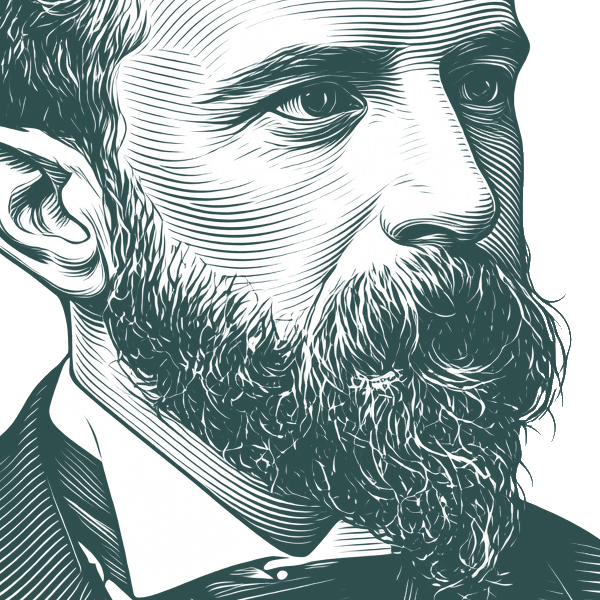
Henry Adams
Henry Brooks Adams (16 February 1838 – 27 March 1918) was a U.S. historian, journalist, novelist and educator. He was the great-grandson of John Adams, grandson of John Quincy Adams and son of Charles Francis Adams, Sr.
Biography information from
Wikiquote·
Portrait adapted from
Wikimedia Commons, William Notman (Public domain / CC0)
Pearson shut out of science everything which the nineteenth-century had brought into it. He told his scholars that they must put up with a fraction of the universe, and a very small fraction at that — the circle reached by the senses, where sequence could be taken for granted.
Practical politics consists in ignoring facts, but education and politics are two different and often contradictory things.
Indeed, had his father kept the boy at home, and given him half an hour's direction every day, he would have done more for him than school ever could do for them. Of course, school-taught men and boys looked down on home-bred boys, and rather prided themselves on their own ignorance, but the man of sixty can generally see what he needed in life, and in Henry Adams's opinion it was not school.