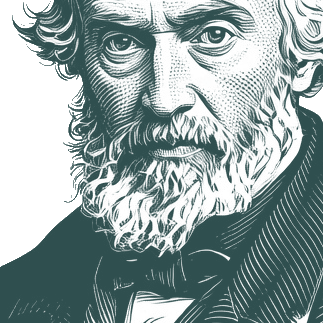
At bottom, it is the Poet's first gift, as it is all men's, that he have intellect enough. He will be a Poet if he have: a Poet in word; or failing t… - Thomas Carlyle
""
At bottom, it is the Poet's first gift, as it is all men's, that he have intellect enough. He will be a Poet if he have: a Poet in word; or failing that, perhaps still better, a Poet in act. Whether he write at all; and if so, whether in prose or in verse, will depend on accidents: who knows on what extremely trivial accidents, — perhaps on his having had a singing-master, on his being taught to sing in his boyhood! But the faculty which enables him to discern the inner heart of things, and the harmony that dwells there (for whatsoever exists has a harmony in the heart of it, or it would not hold together and exist), is not the result of habits or accidents, but the gift of Nature herself; the primary outfit for a Heroic Man in what sort soever. To the Poet, as to every other, we say first of all, See. If you cannot do that, it is of no use to keep stringing rhymes together, jingling sensibilities against each other, and name yourself a Poet; there is no hope for you. If you can, there is, in prose or verse, in action or speculation, all manner of hope. The crabbed old Schoolmaster used to ask, when they brought him a new pupil, 'But are ye sure he's not a dunce?' Why, really one might ask the same thing, in regard to every man proposed for whatsoever function; and consider it as the one inquiry needful: Are ye sure he's.
Thomas Carlyle (December 4 1795 – February 5 1881) was a Scottish essayist, historian and philosopher of great prominence during the Victorian era. His wife was Jane Welsh Carlyle.
Biography information from
Wikiquote·
Portrait adapted from
Wikimedia Commons, Sir John Everett Millais, 1st Bt (died 1896) (Public domain / CC0)
"Of all the acts of man, repentance is the most divine. The greatest of all faults . . . is to be conscious of none." (Thomas Carlyle)
We are no longer instinctively driven to apprehend, and lay to heart, what is Good and Lovely, but rather to inquire, as onlookers, how it is produced, whence it comes, whither it goes. Our favourite Philosophers have no love and no hatred; they stand among us not to do, nor to create anything, but as a sort of Logic mills, to grind out the true causes and effects of all that is done and created.
PREMIUM FEATURE
Advanced Search Filters
Filter search results by source, date, and more with our premium search tools.
[T]he battling Reformer too is, from time to time, a needful and inevitable phenomenon. Obstructions are never wanting: the very things that were once indispensable furtherances become obstructions; and need to be shaken off, and left behind us,—a business often of enormous difficulty.