He did not know the way things were going: he was too Victorian to understand the Victorian epoch. He did not know enough ignorant people to have hea… - G. K. Chesterton
""
He did not know the way things were going: he was too Victorian to understand the Victorian epoch. He did not know enough ignorant people to have heard the news.
English
Collect this quote
About
G. K. Chesterton
Gilbert Keith Chesterton (29 May 1874 – 14 June 1936) was a British writer whose prolific and diverse output included works of philosophy, ontology, poetry, play writing, journalism, public lecturing and debating, literary and art criticism, biography, Christian apologetics (particularly for Catholicism), and fiction, including fantasy and detective fiction. He has been called the "prince of paradox".
Biography information from
Wikiquote·
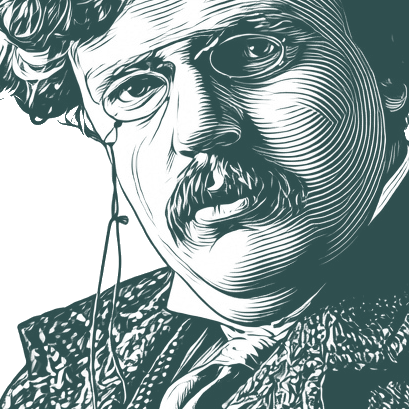
Portrait adapted from
Wikimedia Commons, Ernest Herbert Mills (Public domain / CC0)
Also Known As
Native Name:
Gilbert Keith Chesterton
Alternative Names:
František Kafka
•
Kafka
•
Gilbert K. Chesterton
•
Gilbert Chesterton
•
G.K. Chesterton
•
G. K. C.
In the days when Stevenson's ancestors the Covenanters were fighting with the Cavaliers, a fine old Cavalier of the Episcopalian persuasion made a rather interesting remark; that the change he really hated was represented by saying 'The Lord' instead of 'Our Lord.' The latter implied affection, the former only fear; indeed he described the former succinctly as the talk of devils. And this is so far true that the very eloquent language in which the name of 'The Lord' has figured has generally been the language of might and majesty and even terror. And there really was implied in it in varying degrees the idea of glorifying God for His greatness rather than His goodness. And again there occurred the natural inversion of ideas. Since the Puritan was content to cry with the Moslem: 'God is great,' so the descendant of the Puritan is always a little inclined to cry with the Nietzschean: 'Greatness is God.' In some of the really evil extremes, this sentiment shaded darkly into a sort of diabolism.
Do not enjoy yourself. Enjoy dances and theaters and joy-rides and champagne and oysters; enjoy jazz and cocktails and night-clubs if you can enjoy nothing better; enjoy bigamy and burglary and any crime in the calendar, in preference to the other alternative; but never learn to enjoy yourself.
Unlimited Quote Collections
Organize your favorite quotes without limits. Create themed collections for every occasion with Premium.
We do not really want a religion that is right where we are right. What we want is a religion that is right where we are wrong. We do not want, as the newspapers say, a church that will move with the world. We want a church that will move the world.