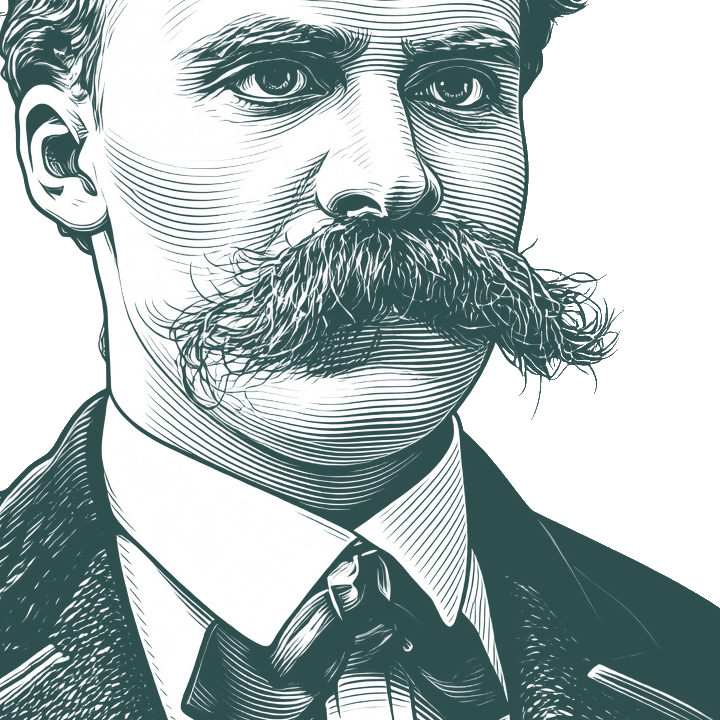
Popular medicine and popular morality belong together and ought not to be evaluated so differently as they still are: both are the most dangerous pse… - Friedrich Nietzsche
""
Popular medicine and popular morality belong together and ought not to be evaluated so differently as they still are: both are the most dangerous pseudo-sciences.
Friedrich Wilhelm Nietzsche (15 October 1844 – 25 August 1900) was a German philosopher, cultural critic, composer, poet, writer, and philologist whose work has exerted a profound influence on modern intellectual history. His critiques of contemporary culture, religion, and philosophy centered on a basic question regarding the foundation of values and morality.
Biography information from
Wikiquote·
Portrait adapted from
Wikimedia Commons, Friedrich Hermann Hartmann (Public domain / CC0)
Also Known As
Alternative Names:
Friedrich Wilhelm Nietzsche
•
Nietzsche
Between two absolutely different spheres, as between subject and object, there is no causality, no correctness, and no expression; there is, at most, an aesthetic relation: I mean, a suggestive transference, a stammering translation into a completely foreign tongue — for which I there is required, in any case, a freely inventive intermediate sphere and mediating force. "Appearance" is a word that contains many temptations, which is why I avoid it as much as possible. For it is not true that the essence of things "appears" in the empirical world. A painter without hands who wished to express in song the picture before his mind would, by means of this substitution of spheres, still reveal more about the essence of things than does the empirical world. Even the relationship of a nerve stimulus to the generated image is not a necessary one. But when the same image has been generated millions of times and has been handed down for many generations and finally appears on the same occasion every time for all mankind, then it acquires at last the same meaning for men it would have if it were the sole necessary image and if the relationship of the original nerve stimulus to the generated image were a strictly causal one. In the same manner, an eternally repeated dream would certainly be felt and judged to be reality. But the hardening and congealing of a metaphor guarantees absolutely nothing concerning its necessity and exclusive justification.
Behold! I am weary of my wisdom, like the bee that has gathered too much honey; I need hands outstretched to take it from me. I wish to spread it and bestow it, until the wise have once more become joyous in their folly, and the poor happy in their riches.
Enhance Your Quote Experience
Enjoy ad-free browsing, unlimited collections, and advanced search features with Premium.