Unlimited Quote Collections
Organize your favorite quotes without limits. Create themed collections for every occasion with Premium.
" "There is nothing very odd about lambs disliking birds of prey, but this is no reason for holding it against large birds of prey that they carry off lambs. And when the lambs whisper among themselves, 'These birds of prey are evil, and does this not give us a right to say that whatever of the opposite of a bird of prey must be good?', there is nothing intrinsically wrong with such an argument - though the birds of prey will look somewhat quizzically and say, 'Wehave nothing against these good lambs; in fact, we love them; nothing tastes better than a tender lamb.
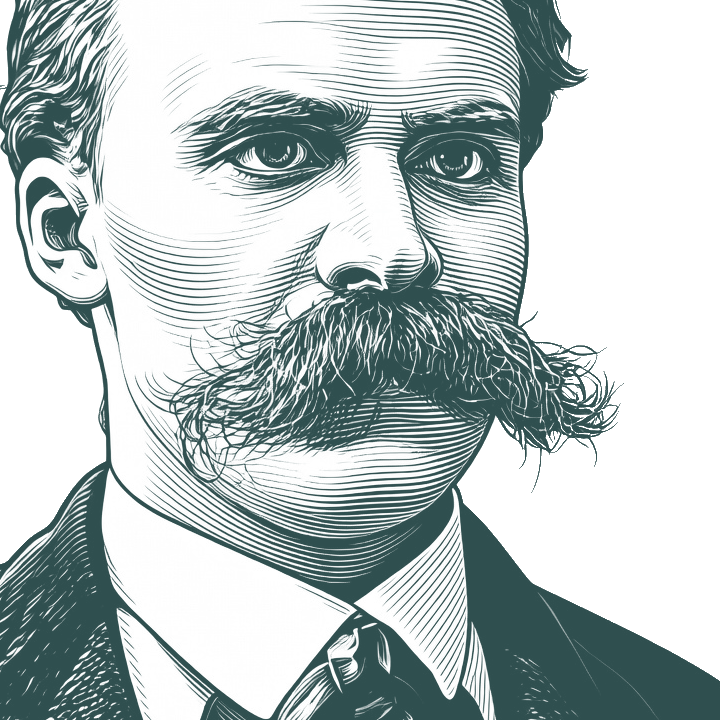
Friedrich Wilhelm Nietzsche (15 October 1844 – 25 August 1900) was a German philosopher, cultural critic, composer, poet, writer, and philologist whose work has exerted a profound influence on modern intellectual history. His critiques of contemporary culture, religion, and philosophy centered on a basic question regarding the foundation of values and morality.
Biography information from Wikiquote
Organize your favorite quotes without limits. Create themed collections for every occasion with Premium.
Related quotes. More quotes will automatically load as you scroll down, or you can use the load more buttons.
It is much more agreeable to offend and later ask forgiveness than to be offended and grant forgiveness. The one who does the former demonstrates his power and then his goodness. The other, if he does not want to be thought inhuman, must forgive; because of this coercion, pleasure in the other's humiliation is slight.
Whom do I hate most among the rabble of today? The socialist rabble, the chandala apostles, who undermine the instinct, the pleasure, the worker's sense of satisfaction with his small existence–who make him envious, who teach him revenge. The source of wrong is never unequal rights but the claim of “equal” rights.
Filter search results by source, date, and more with our premium search tools.
In my opinion, Henrik Ibsen has become very German. With all his robust idealism and "Will to Truth," he never dared to ring himself free from moral-illusionism which says "freedom," and will not admit, even to itself, what freedom is: the second stage in the metamorphosis of the "Will to Power" in him who lacks it. In the first stage, one demands justice at the hands of those who have power. In the second, one speaks of "freedom," that is to say, one wishes to "shake oneself free" from those who have power. In the third stage, one speaks of "equal rights"—that is to say, so long as one is not a predominant personality one wishes to prevent one's competitors from growing in power.