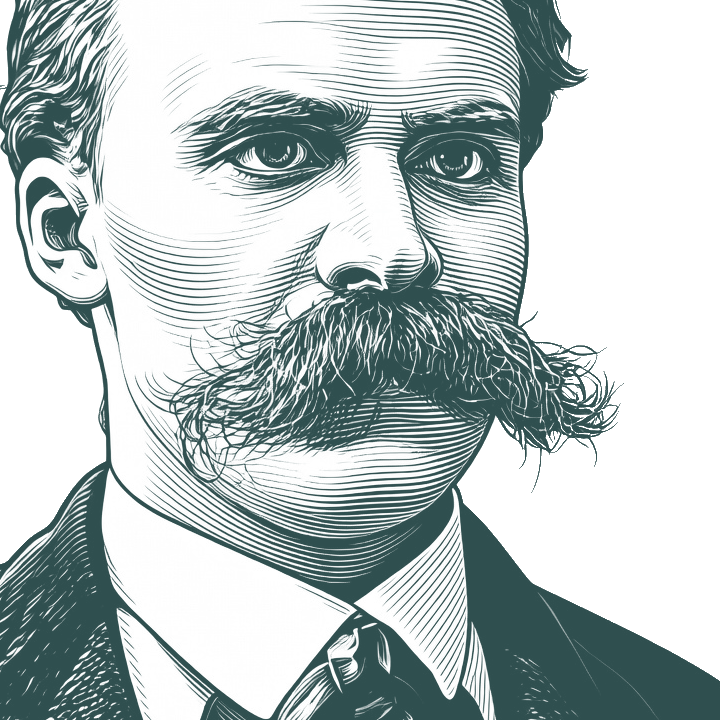
Whoever knows he is deep, strives for clarity; whoever would like to appear deep to the crowd, strives for obscurity. For the crowd considers anythin… - Friedrich Nietzsche
""
Whoever knows he is deep, strives for clarity; whoever would like to appear deep to the crowd, strives for obscurity. For the crowd considers anything deep if only it cannot see to the bottom: the crowd is so timid and afraid of going into the water.
Friedrich Wilhelm Nietzsche (15 October 1844 – 25 August 1900) was a German philosopher, cultural critic, composer, poet, writer, and philologist whose work has exerted a profound influence on modern intellectual history. His critiques of contemporary culture, religion, and philosophy centered on a basic question regarding the foundation of values and morality.
Biography information from
Wikiquote·
Portrait adapted from
Wikimedia Commons, Friedrich Hermann Hartmann (Public domain / CC0)
Also Known As
Alternative Names:
Friedrich Wilhelm Nietzsche
•
Nietzsche
"The state, I call it, where all are poison-drinkers, the good and the bad: the state, where all lose themselves, the good and the bad: the state, where the slow suicide of all — is called "life." Just see these superfluous ones! They steal the works of the inventors and the treasures of the wise. Culture, they call their theft — and everything becometh sickness and trouble unto them! Just see these superfluous ones! Sick are they always; they vomit their bile and call it a newspaper. They devour one another, and cannot even digest themselves."
Against the censurers of brevity. - Something said briefly can be the fruit of much long thought: but the reader who is a novice in this field, and has as yet reflected on it not at all, sees in everything said briefly something embryonic, not without censuring the author for having served him up such immature and unripened fare.
Go Premium
Support Quotewise while enjoying an ad-free experience and premium features.
"Man is the cruelest animal," says Zarathustra. "When gazing at tragedies, bull-fights, crucifixations he hath hitherto felt happier than at any other time on Earth. And when he invented Hell...lo, Hell was his Heaven on Earth"; he could put up with suffering now, by contemplating the eternal punishment of his oppressors in the other world.