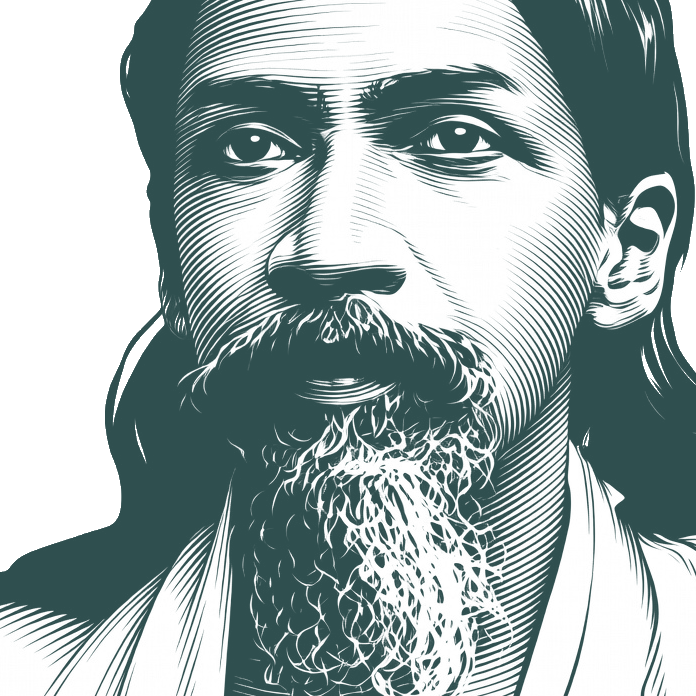
I do not care a button about having my name in any blessed place. I was never ardent about fame even in my political days; I preferred to remain behi… - Aurobindo Ghosh
""
I do not care a button about having my name in any blessed place. I was never ardent about fame even in my political days; I preferred to remain behind the curtain, push people without their knowing it and get things done. It was the confounded British Government that spoiled my game by prosecuting me and forcing me to be publicly known and a 'leader'. Then, again, I don't believe in advertisement except for books etc., and in propaganda except for politics and patent medicines. But for serious work it is a poison. It means either a stunt or a boom' and stunts and booms exhaust the thing they carry on their crest and leave it lifeless and broken high and dry on the shores of nowhere... or it means a movement. A movement in the case of a work like mine means the founding of a school or a sect or some other damned nonsense. It means that hundreds or thousands of useless people join in and corrupt the work or reduce it to a pompous farce from which the Truth that was coming down recedes into secrecy and silence. It is what has happened to the 'religions' and is the reason of their failure. If I tolerate a little writing about myself, it is only to have a sufficient counter-weight in that amorphous chaos, the public mind, to balance the hostility that is always aroused by the presence of a new dynamic Truth in this world of ignorance. But the utility ends there and too much advertisement would defeat that object. I am perfectly 'rational', I assure you, in my methods and I do not proceed merely on any personal dislike of fame. If and so far as publicity serves the Truth, I am quite ready to tolerate it; but I do not find publicity for its own sake desirable.
Sri Aurobindo [born Aravinda Akroyd Ghose] (15 August 1872 – 5 December 1950) was an Indian nationalist, scholar, poet, mystic, philosopher, yogi and guru, who developed concepts of human progress and spiritual evolution. With the help of his spiritual collaborator, Mirra Alfassa, he founded the Sri Aurobindo Ashram.
Biography information from
Wikiquote·
Portrait adapted from
Wikimedia Commons, Rudolf 1922 (Public domain / CC0)
Also Known As
Native Name:
অরবিন্দ ঘোষ
Alternative Names:
Sri Aurobindo Ghose
•
Sri Orobindo
•
Orobindo Ghosh
•
Shri Aurobindo
•
Aurobindo Ghose
•
Sri Aurobindo
•
Aurobindo
•
Aravinda Ackroyd Ghose
•
A.A.Ghosh
•
A.G.
•
Maharshi Aravind Babu
The Hindu religion appears … as a cathedral temple, half in ruins, noble in the mass, often fantastic in detail but always fantastic with a significance — crumbling or badly outworn in places, but a cathedral temple in which service is still done to the Unseen and its real presence can be felt by those who enter with the right spirit.
It is true that the subliminal in man is the largest part of his nature and has in it the secret of the unseeen dynamisms which explain his surface activities. But the lower vital subconscious which is all that this psycho-analysis of Freud seems to know, - and of that it knows only a few ill-lit corners, - is no more than a restricted and very inferior portion of the subliminal whole... to begin by opening up the lower subconscious, risking to raise up all that is foul or obscure in it, is to go out of one's way to invite trouble.
Works in ChatGPT, Claude, or Any AI
Add semantic quote search to your AI assistant via MCP. One command setup.
Nothing can be more untrue than to pretend that the general religious mind of India has not at all grasped the higher spiritual or metaphysical truths of Indian religion. It is a sheer falsehood or a wilful misunderstanding to say that it has lived always in the externals only of rite and creed and shibboleth. On the contrary, the main metaphysical truths of Indian religious philosophy in their broad idea-aspects or in an intensely poetic and dynamic representation have been stamped on the general mind of the people. The ideas of Maya, Lila, divine Immanence are as familiar to the man in the street and the worshipper in the temple as to the philosopher in his seclusion, the monk in his monastery and the saint in his hermitage. The spiritual reality which they reflect, the profound experience to which they point, has permeated the religion, the literature, the art, even the popular religious songs of a whole people.