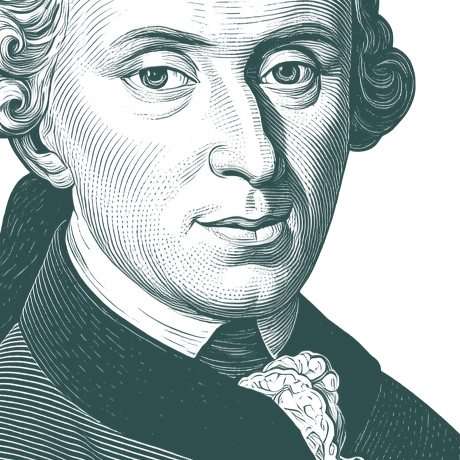
[A man] finds himself forced by necessity to borrow money. He knows that he will not be able to repay it, but sees also that nothing will be lent to … - Immanuel Kant
""
[A man] finds himself forced by necessity to borrow money. He knows that he will not be able to repay it, but sees also that nothing will be lent to him unless he promises stoutly to repay it in definite time. He desires to make this promise, but he has still so much conscience as to ask himself: Is it not unlawful and inconsistent with duty to get out of a difficulty in this way? Suppose, however, that he resolves to do so, then the maxim of his action would be expressed thus: When I think myself in want of money, I will borrow money and promise to repay it, although I know that I never can do so. Now this principle of self-love or of one's own advantage may perhaps be consistent with my whole future welfare; but the question now is, Is it right? I change then the suggestion of self-love into a universal law, and state the question thus: How would it be if my maxim were a universal law? Then I see at once that it could never hold as a universal law of nature, but would necessarily contradict itself. For supposing it to be a universal law that everyone when he thinks himself in a difficulty should be able to promise whatever he pleases, with the purpose of not keeping his promise, the promise itself would become impossible, as well as the end that one might have in view in it, since no one would consider that anything was promised to him, but would ridicule all such statements as vain pretenses.
It is absurd to excite reason against the primary postulates of pure time, as, for example, continuity, etc., since they follow from laws prior and superior to which nothing is found, and since reason herself in the use of the principle of contradiction cannot dispense with the support of this concept, so primitive and original is it.