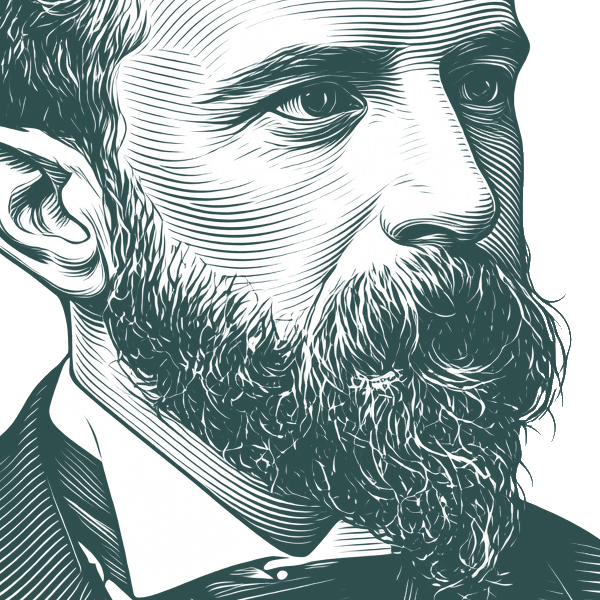
Henry Brooks Adams (16 February 1838 – 27 March 1918) was a U.S. historian, journalist, novelist and educator. He was the great-grandson of John Adams, grandson of John Quincy Adams and son of Charles Francis Adams, Sr.
Biography information from
Wikiquote·
Portrait adapted from
Wikimedia Commons, William Notman (Public domain / CC0)
He was the more surprised to see that Sumner invited a renewal of old relations. He found himself treated almost confidentially. Not only was he asked to make a fourth at Sumner's pleasant little dinners in the house on La Fayette Square, but he found himself admitted to the Senator's study and informed of his views, policy and purposes, which were sometimes even more astounding than his curious gaps or lapses of omniscience. On the whole, the relation was the queerest that Henry Adams ever kept up. He liked and admired Sumner, but thought his mind a pathological study. At times he inclined to think that Sumner felt his solitude, and, in the political wilderness, craved educated society; but this hardly told the whole story. Sumner's mind had reached the calm of water which receives and reflects images without absorbing them; it contained nothing but itself.
Charles Francis Adams was singular for mental poise — absence of self-assertion or self-consciousness — the faculty of standing apart without seeming aware that he was alone — a balance of mind and temper that neither challenged nor avoided notice, nor admitted question of superiority or inferiority, of jealousy, of personal motives, from any source, even under great pressure.
Monckton Milnes was a social power in London, and of course he himself affected social eccentricity, challenging ridicule with the indifference of one who knew himself to be the first wit in London, and a maker of men — of a great many men. A word from him went far. An invitation to his breakfast-table went farther. Behind his almost Falstaffian mask and laugh of Silenus, he carried a fine, broad, and high intelligence which no one questioned. As a young man he had written verses, which some readers thought poetry, and which were certainly not altogether prose. Later, in Parliament he made speeches, chiefly criticised as too good for the place and too high for the audience. Socially, he was one of two or three men who went everywhere, knew everybody, talked of everything.