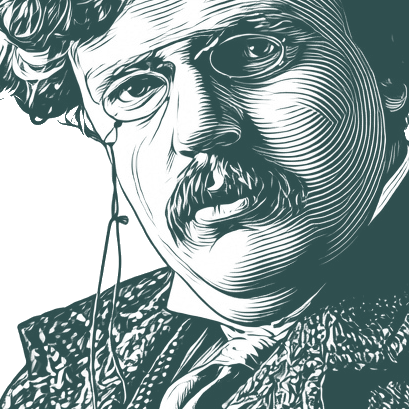
The greatest of poems is an inventory. Every kitchen tool becomes ideal because Crusoe might have dropped it in the sea. It is a good exercise, in em… - G. K. Chesterton

" "

The greatest of poems is an inventory.
Every kitchen tool becomes ideal because Crusoe might have dropped it
in the sea. It is a good exercise, in empty or ugly hours of the day, to
look at anything, the coal-scuttle or the book-case, and think how happy
one could be to have brought it out of the sinking ship on to the
solitary island.

English
Collect this quote

About G. K. Chesterton

Gilbert Keith Chesterton (29 May 1874 – 14 June 1936) was a British writer whose prolific and diverse output included works of philosophy, ontology, poetry, play writing, journalism, public lecturing and debating, literary and art criticism, biography, Christian apologetics (particularly for Catholicism), and fiction, including fantasy and detective fiction. He has been called the "prince of paradox".

Biography information from Wikiquote

Also Known As

Native Name: Gilbert Keith Chesterton
Alternative Names: František Kafka Kafka Gilbert K. Chesterton Gilbert Chesterton G.K. Chesterton G. K. C.
Unlimited Quote Collections

Organize your favorite quotes without limits. Create themed collections for every occasion with Premium.

Related quotes. More quotes will automatically load as you scroll down, or you can use the load more buttons.

Additional quotes by G. K. Chesterton

Los cuentos de hadas superan la realidad no porque nos digan que los dragones existen, sino porque nos dicen que pueden ser vencidos.

The wisest thing in the world is to cry out before you are hurt. It is no good to cry out after you are hurt; especially after you are mortally hurt. People talk about the impatience of the populace; but sound historians know that most tyrannies have been possible because men moved too late. it is often essential to resist a tyranny before it exists.

Go Premium

Support Quotewise while enjoying an ad-free experience and premium features.

View Plans
As we have taken the circle as a symbol of reason and madness, we may very well take the cross as a symbol at once of mystery and health. Buddhism is centripetal, but Christianity is centrifugal: it breaks out. For the circle is perfect and infinite in its nature; but it is fixed for ever in its size; it can never be larger or smaller. But the cross, though it has at its head a collision and a contradiction, can extend its four arms for ever without altering its shape. Because is has a paradox in its center it can grow without changing. The circle returns upon itself and is bound. The cross opens its arms to the four winds; it is a signpost for free travelers.

Loading...