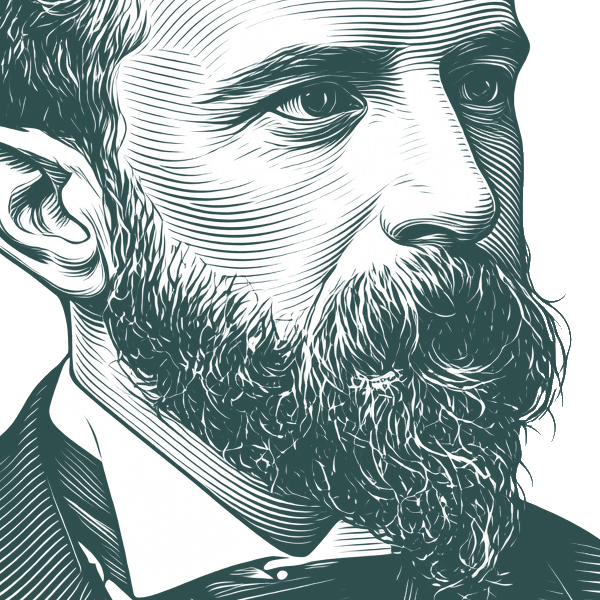
Henry Brooks Adams (16 February 1838 – 27 March 1918) was a U.S. historian, journalist, novelist and educator. He was the great-grandson of John Adams, grandson of John Quincy Adams and son of Charles Francis Adams, Sr.
Biography information from
Wikiquote·
Portrait adapted from
Wikimedia Commons, William Notman (Public domain / CC0)
The trait that astounded and confounded cynicism was his apparent unselfishness. Never, in any man who wielded such power, did Henry Adams meet anything like it. The effect of power and publicity on all men is the aggravation of self, a sort of tumor that ends by killing the victim's sympathies; a diseased appetite, like a passion for drink or perverted tastes; one can scarcely use expressions too strong to describe the violence of egotism it stimulates; and Turlow Weeds was one of the exceptions; a rare imune. He thought apparently not of himself, but of the person he was talking with. He held himself naturally in the background. He was not jealous. He grasped power, but not office. He distributed offices by handfuls without caring to take them. He had the instinct of empire: he gave, but he did not receive.
As for myself, if I could have removed my doubts by so simple a step as that of becoming an atheist, I should have done it, no matter what scandal or punishment had followed. I studied the subject thoroughly, and found that for one doubt removed, another was raised, only to reach at last a result more inconceivable than that reached by the church, and infinitely more hopeless besides. What do you gain by getting rid of one incomprehensible only to put a greater one in its place, and throw away your only hope besides? The atheists offer no sort of bargain for one's soul. Their scheme is all loss and no gain. At last both they and I come back to a confession of ignorance; the only difference between us is that my ignorance is joined with a faith and hope.
Try QuoteGPT
Chat naturally about what you need. Each answer links back to real quotes with citations.
If there was in all France, between 1140 and 1200, a more typical Englishman of the future Church of England type than John of Salisbury, he has left no trace; and John wrote a description of his time which makes a picturesque contrast with the picture painted by Abélard, his old master, of the century at its beginning. John weighed Abélard and the Schools against Bernard and the Cloister, and coolly concluded that the way to truth lay rather through Citeaux, which brought him to Chartres as Bishop in 1176, and to a mild scepticism in faith. "I prefer to doubt," he said, "rather than rashly define what is hidden."