Einstein had been fascinated by Bernstein’s People’s Book of Natural Science, a popularization of science that described on its very first page the a… - Carl Sagan
""
Einstein had been fascinated by Bernstein’s People’s Book of Natural Science, a popularization of science that described on its very first page the astonishing speed of electricity through wires and light through space. He wondered what the world would look like if you could travel on a wave of light. To travel at the speed of light? What an engaging and magical thought for a boy on the road in a countryside dappled and rippling in sunlight.
English
Collect this quote
About
Carl Sagan
Carl Edward Sagan (9 November 1934 – 20 December 1996) was an American astronomer, planetary scientist, cosmologist, astrophysicist, astrobiologist, author, and science communicator. His best known scientific contribution is research on extraterrestrial life, including experimental demonstration of the production of amino acids from basic chemicals by radiation. Sagan assembled the first physical messages sent into space, the Pioneer plaque and the Voyager Golden Record, universal messages that could potentially be understood by any extraterrestrial intelligence that might find them. Sagan argued the hypothesis, accepted since, that the high surface temperatures of Venus can be attributed to, and calculated using, the greenhouse effect. He testified to the US Congress in 1985 that the greenhouse effect will change the earth's climate system.
Biography information from
Wikiquote·
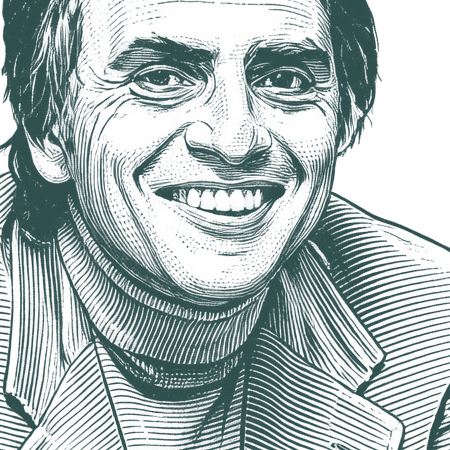
Portrait adapted from
Wikimedia Commons, NASA/JPL (Public domain / CC0)
Also Known As
Native Name:
Carl Edward Sagan
Alternative Names:
Sagan
•
Carl E. Sagan
•
Carl E Sagan
•
C. E. Sagan
•
C.E. Sagan
•
C E Sagan
•
C. Sagan
•
C Sagan
•
Sagan C
•
Sagan C.
•
Sagan C. E.
•
Sagan CE
we still talk about the Sun “rising” and the Sun “setting.” It is 2,200 years since Aristarchus, and our language still pretends that the Earth does not turn.
We know that at least some terrestrial microbes can survive on Mars. What is necessary is a program of artificial selection and genetic engineering of dark plants — perhaps lichens — that could survive the much more severe Martian environment. If such plants could be bred, we might imagine them being seeded on the vast expanse of the Martian polar ice caps, taking root, spreading, blackening the ice caps, absorbing sunlight, heating the ice, and releasing the ancient Martian atmosphere from its long captivity.
Enhance Your Quote Experience
Enjoy ad-free browsing, unlimited collections, and advanced search features with Premium.