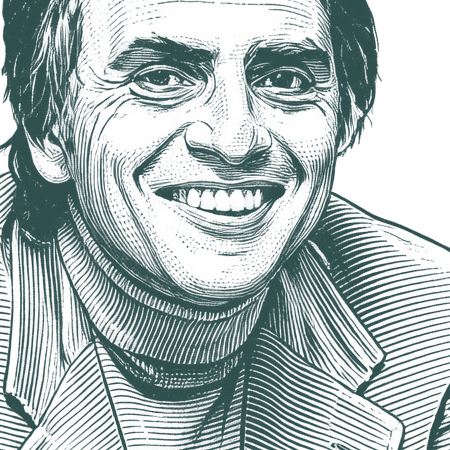
It took the Church until 1832 to remove Galileo's work from its list of books which Catholics were forbidden to read at the risk of dire punishment o… - Carl Sagan
""
It took the Church until 1832 to remove Galileo's work from its list of books which Catholics were forbidden to read at the risk of dire punishment of their immortal souls.
English
Collect this quote
About
Carl Sagan
Carl Edward Sagan (9 November 1934 – 20 December 1996) was an American astronomer, planetary scientist, cosmologist, astrophysicist, astrobiologist, author, and science communicator. His best known scientific contribution is research on extraterrestrial life, including experimental demonstration of the production of amino acids from basic chemicals by radiation. Sagan assembled the first physical messages sent into space, the Pioneer plaque and the Voyager Golden Record, universal messages that could potentially be understood by any extraterrestrial intelligence that might find them. Sagan argued the hypothesis, accepted since, that the high surface temperatures of Venus can be attributed to, and calculated using, the greenhouse effect. He testified to the US Congress in 1985 that the greenhouse effect will change the earth's climate system.
Biography information from
Wikiquote·
Portrait adapted from
Wikimedia Commons, NASA/JPL (Public domain / CC0)
Also Known As
Native Name:
Carl Edward Sagan
Alternative Names:
Sagan
•
Carl E. Sagan
•
Carl E Sagan
•
C. E. Sagan
•
C.E. Sagan
•
C E Sagan
•
C. Sagan
•
C Sagan
•
Sagan C
•
Sagan C.
•
Sagan C. E.
•
Sagan CE
[Science] works. It is not perfect. It can be misused. It is only a tool. But it is by far the best tool we have, self-correcting, ongoing, applicable to everything. It has two rules. First: there are no sacred truths; all assumptions must be critically examined; arguments from authority are worthless. Second: whatever is inconsistent with the facts must be discarded or revised. We must understand the Cosmos as it is and not confuse how it is with how we wish it to be. The obvious is sometimes false; the unexpected is sometimes true.
We can pray over the cholera victim, or we can give her 500 milligrams of tetracycline every 12 hours. (There is still a religion, Christian Science, that denies the germ theory of disease; if prayer fails, the faithful would rather see their children die than give them antibiotics.) We can try nearly futile psychoanalytic talk therapy on the schizophrenic patient, or we can give him 300 to 500 milligrams a day of clozapine. The scientific treatments are hundreds or thousands of times more effective than the alternatives. (And even when the alternatives seem to work, we don’t actually know that they played any role: Spontaneous remissions, even of cholera and schizophrenia, can occur without prayer and without psychoanalysis.) Abandoning science means abandoning much more than air conditioning, CD players, hair dryers, and fast cars.
Works in ChatGPT, Claude, or Any AI
Add semantic quote search to your AI assistant via MCP. One command setup.
I don't think science is hard to teach because humans aren't ready for it, or because it arose only through a fluke, or because, by and large, we don't have the brainpower to grapple with it. Instead, the enormous zest for science that I see in first-graders and the lesson from the remnant hunter-gatherers both speak eloquently: A proclivity for science is embedded deeply within us, in all times, places, and cultures. It has been the means for our survival. It is our birthright. When, through indifference, inattention, incompetence, or fear of skepticism, we discourage children from science, we are disenfranchising them, taking from them the tools needed to manage their future.